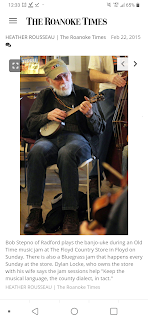
Surprises: Session leader Mac Traynham playing rhythm guitar instead of his usual fiddle or banjo, and my arriving in time to catch a seat between Mac and Radford neighbors Linda Frank & Chip Arnold.
I will send the photographer a note asking permission to "reprint" her close-up of the guy in the NPR cap playing a not-so-traditional banjo ukulele... But since it is property of the Roanoke Times, you might as well just go there and enjoy the whole presentation... if you haven't already been there via the flurry of posts on Facebook.
(note:thisismy first attempt to use anAndroid phone app to post toblogger. I may have to come back and fixthe link, edit embarrassing autocorrect errors, or something.)
This page has been updated many times since 2015, when the announcement of a Blacksburg and New River Valley ukulele get together inspired me to look into the past of ukulele playing in the region's oldtime music communities... My goal was to tell uke players that they didn't need to look for uke-only events, that they would not necessarily be met with scorn and derision at mixed jam sessions in the area, if they were willing to listen, learn some traditional old time string band tunes -- and keep within the style.
As I eventually learned, while they took a minor supporting role, ukes appeared to have been infiltrating old time music recordings in a small way even before John Hopkins' started strumming his triplets on a banjo ukulele loud and clear in the original "Hill Billies," 1926:
Blue Ridge Mountain Blues - The Hill Billies 1926!
"Al Hopkins ... was the leader of his own band called the Hill Billies (also known as the Buckle Busters). The band members consisted of Al Hopkins (piano), John Hopkins (ukulele), Joe Hopkins (guitar), John Rector (banjo), and Tony Alderman (fiddle).
"The Hill Billies had been discovered by Ralph Peer a year earlier and had made some records for Okeh (a forerunner of Columbia). When Ralph Peer asked Al Hopkins the name of his band, Al responded “We ain’t nothing but a bunch of hillbillies from North Carolina and Virginia. You can just call us anything.” Mr. Peer appropriately named them the “Hill Billies”.
I first heard the banjo ukulele played with a fiddle and 5-string banjo in the late 1970s or early 1980s by a more contemporary band, the Horse Flies from Ithaca, N.Y.
Alternating between guitar and banjo uke, depending on the tune, Jeff Claus provided a rock-solid rhythm for the band. I have seen an interview with him somewhere referring to the instrument as "a drum on a stick."
Another contemporary player, John Kelley, headed his web essay and instructional page about the instrument, "Banjo Uke -- the Tommy Gun of old time music!"
However, not all old time Fiddlers will appreciate having a Tommy Gun in their local jam session. It is best to ask, or be very sensitive to icy stares!
This picture turned up in an oldtime radio discussion forum... I had no idea George Gobel started out as an adolescent radio-barn-dance ukulele player during his "Georgie" days! By the 1950s when I first saw him, he was much better known as Ernie Ford's "little bitty buddy" strumming orchestral jazz chords on an oversize Gibson Super 400 guitar along with the jokes and songs on TV.
That big Gibson was almost part of the joke itself, looking out of proportion strapped around the diminutive crewcut Goble. Result: Gibson even named a custom smaller, slimmer jazz guitar after him. (I haven't seen any archival clips showing him going back to the ukulele, but wouldn't be surprised if that didn't turn up in one of Gobel and Ford's TV comedy skits.)
"He was one of the favorites, as well as the youngest performer at the time on WLS' National Barn Dance, a homegrown program which was hugely popular from its inception in 1924 and enduring for over 50 years. George's era started with his debut in 1933. George played the ukulele, which was not a union instrument, thereby avoiding paying union dues."
(Or maybe that was just a punchline in George's transition from mostly-musician to mostly-comedian?
I have been going to the wonderful twice-a-year Lake Eden Arts Festival (http://theLEAF.org) for almost 20 years, off and on, and have several ancient T-shirts to show for it. (This commemorative-T-shirt thing may prove embarrassing at a contra dance when one's partner notices a year on a shirt, does the math, and realizes this guy is wearing underwear older than she is.)
This fall I decided to pass up the T-shirt stand and contribute to the support of LEAF by buying some raffle tickets instead. The decision was a very lucky one...
Jay Lichty of Tryon, N.C., (http://lichtyguitars.com) built this one-of-a-kind ukulele and donated it to LEAF for the benefit raffle. He used all-recycled woods... a North Carolina mountain cabin's floor for the back and sides, a retired mahogany bedpost for the neck, and "sunken cedar" for the top. Because of the instrument's North Carolina roots -- and the underwater cedar -- Doc Watson's "Deep River Blues" seemed an appropriate first tune to play. I gave it a try in the LEAF office when I showed up to claim the prize, and then played it again at home to make this rough little video.
Don't worry, I didn't think my singing would add anything to the ukulele demo. (Incidentally, this is my first experience with a "low-G" tenor ukulele, which seemed especially well suited to a slight adaptation of the guitar arrangement of this tune.) If you'd like to sing along, I found the "Deep River Blues" lyrics over at the Digital Tradition collection at the Mudcat Cafe, a great resource for folksong fans.
Jay himself recorded a few tunes with the uke and put them on his website. They give a much better indication of the range of this lovely instrument. They also may have been recorded with a much better microphone -- or the uke's built-in pickup, which I didn't even notice until I'd owned it for a few days. (Since that page of his was for the raffle -- which is now over -- I don't know how long he'll keep it around.)
I found out later he had posted photos of the uke under construction, and they are still there.
Unfortunately, all I had handy was my MacBook with its built-in camera and microphone, which I figured would be fine a test drive at the uploading process. YouTube didn't want to accept the original file, so I uploaded it directly with Blogger -- which may only have a "Flash" player for videos, making the clip invisible to iPads and other discerning devices.
Since then, I've tried some file-conversion software, which appeared to solve YouTube's problem with accepting the original file. Using Blogger's "insert from YouTube" setting still produces a rather small display window on this page and still seems to only offer a Flash video player, but the quality of the video itself seems better than the original. I've linked the still image above to YouTube for a larger-format display.
For any Web production students curious about my video problems, I've included both versions below.
After years of mostly using WordPress blogs, I clearly have to refresh my knowledge of the current version of Blogger! But playing the ukulele is much more fun. If your device won't play the video in this window, just follow this link to launch the video in YouTube itself: http://youtu.be/0L9PyUTHqlU
My "Firefly" banjo-uke raises a few eyebrows around old-time Appalachian music sessions, so I thought I'd put some links here... And maybe a YouTube video of myself when I get around to it. (This is also my first attempt at posting to this old blogger blog from an iPad, so some editing and correction of links and players for other folks' YouTube videos may be necessary.)
It has four nylon strings (like a uke) and a drum-head (like a banjo). It also tunes uke style, g-C-E-a, with the two outside strings being the highest pitches. The high "g" is the string closest to the thumb, which is also true of the five-string banjo. That coincidence has inspired me to experiment with playing in a "claw hammer" oldtime banjo style, as well as more traditional uke strumming and picking styles.
In addition to playing it in Radford, Blacksburg and Floyd, I've inflicted it on that old gang of mine in Connecticut in December, strumming along on sea chanteys and drinking songs in the pub: Http://thejovialcrew.com/?page_id=1475
The Firefly is a modern design from a Massachusetts company called http://MagicFluke.com -- I bought mine from http://MimsUkes.com in Floyd, Va., so that I could try it first. I like it because it is incredibly light and, with an extra-long neck, can be adapted to play in more keys, using a capo for some tunes in the keys of A and D.
Here's "Redhaired Boy," usually played in A on fiddle, but sometimes sung as the Irish ditty "Little Beggarman" in other keys. I have experimented with it in both key of C and key of D fingerings on the banjo ukulele.
The first time I saw the banjo uke merging with oldtime tunes was 30-some years ago, in the hands of Jeff Claus of the Horseflies, providing a driving rhythm for the band's neo-primitive bug music. More recent example: http://www.youtube.com/watch?v=FaVFzdroXKg
There's no Firefly-Horseflies connection, as far as I know, but stranger things have happened. TheFirefly's lightness I mentioned is the result of MagicFluke's buying the "drum" shell and its synthetic head already molded or cemented together. There are no metal mounting brackets (originally needed to adjust the tension of humidity-sensitive natural skin banjoheads) and no wood and metal resonator like some 1920s models. As a result I can head for a jam session carrying a guitar, a mandolin, and the Firefly without needing a cart or pack animal, or feeling like one. And it is so much fun that I often wind up leaving the guitar at home.
Curiously, the razzmatazz strumming style banjo-uke (a.k.a. banjolele) has quite a following in the U.K. (No U.K./uke pun intended) because of a 1930s-40s comedian, singer, actor and pop star named George Formby, who never quite caught on in the States. The George Formby Society (http://www.georgeformby.co.uk) keeps his legend alive and active over there (http://www.georgeformby.co.uk/news/morecambe/130214.html).
For a frighteningly modern development, explore the phenomenon called "chap-hop."
Radford University Appalachian Awareness Day is Friday February 21, 2014... And I've had my awareness raised enough at previous years' versions to want to help get the word out with a plain-text barebones version of the schedule.
A day of 50-minute sessions, starting at 10 a.m. Free and open to the public, in the Bonnie Hurlburt Student Center Auditorium (“The Bonnie”), on Jefferson Street between Fairfax and Clement Streets.
I'm especially looking forward to the two history-minded 5-string virtuosos speaking -- and, I suspect, picking a bit -- at 3p.m. Feel free to send this page to anyone else who can't easily read the colorful PDF flyer the sponsors have been sending around. I just wanted this here to link to my calendar... And I hope the school paper will dig up a little more about each event. For more information, see the Facebook group for the Appalachian Events Committee: https://www.facebook.com/#!/groups/104447406262763/
It should be listed here too... http://www.radford.edu/content/radfordcore/home/news/calendar.html
Appalachian Innovation is the day's theme...
10am: Putting Education In Its Place
Roots with Wings: Floyd County Place-based Oral History Project
The Floyd Story Center at the Old Church Gallery
11am: Southern Appalachian Mountain Stewards
Dawn Hooper & Barbara Williamson
Noon: Good People Good Food
Tenley Weaver, Christie Pugh, & Dennis Dove
1pm: Education Innovation: The Contemplative & Progressive Way
Dr. Kristan Morrison of the Blue Mountain School
2pm: The Crooked Road
Jack Hinshelwood
3pm: Banjo-Nation Innovation
Stylistic & Structural Evolution of the 5-String Banjo
David Wooldridge & Bud Bennett
I've been playing in old-time and bluegrass sessions several nights a week for the past six months, including the RadfordFiddle.com jam on Mondays, a smaller (less old-time) Radford Pizza House session on Tuesdays, the Blacksburg old-time gathering at the Farmers Market on Wednesdays, the street sessions that spread out from the always-packed Friday Jamboree at the Floyd Country Store, and the Sunday afternoon jam, also at the Floyd Country Store.
Most of these venues have some status on Virginia's Crooked Road, a tourism-oriented attempt to map locations for old-time music in the state that really seems to work: I've met musicians from Holland, Germany, the U.K., Ireland and Australia at one or more of these events, and most mentioned that "Crooked Road" venues were on their touring agenda, along with summer music festivals in West Virginia, Tennessee and North Carolina.
This page will make a good parking space for links to longer articles about the Crooked Road:
I've been telling folks about this song for a couple of years -- usually after they play the tune "St. Anne's Reel" bluegrass style, faster than I can make my fingers move on the mandolin, probably faster than would be comfortable to dance to... and certainly faster than most folks could sing David Mallett's sweet song inspired by the old dance tune.
Today I finally decided to go looking, and found a video of the author singing "The Ballad of St. Anne's Reel" himself -- complete with symphony orchestra.
In case the embedded video doesn't work here, you'll find the original on David Mallett's own page. You may see some other tunes that John Denver and others helped popularize.
Meanwhile, for the tune itself, here's a lovely ensemble from both sides of the pond playing it on fiddle, dobro and guitar (Aly Bain, Jerry Douglas and Russ Barenberg, respectively):
While this was a more general blog at first, since 2009, Boblog has been for occasional writing about music, part of trying to differentiate my web writing spaces. My other blogs are JHeroes (old-time radio's portrayal of journalists) & Other Journalism, a general-purpose writerly blog, successor to stepno.com/oldblog. When I was teaching, they all sometimes served other purposes.
I have worked for two newspapers (one full time for 11 years), several magazines, four software companies, and six colleges and universities, counting part-time, freelance and student jobs. See stepno.com.



 This page will make a good parking space for links to longer articles about the Crooked Road:


 Posts

