Oldtime music crossover...
While looking for the words to a less-often-heard "shindig in the barn" verse to "Blue Ridge Mountain Blues," I found several "discography" lists, including the two recordings as "Blue Ridge Blues" below... George Reneau's was apparently the first recording of the song. And Lulu Jackson's version gets left out of some of the "country music" or "oldtime music" lists, maybe because it crossed boundaries, but I'd love to read a history about how she wound up recording the song! Her "recitation" of the "There'll be a shindig in the barn" verse is, well, very special.

The song (credited to Cliff Hess under the alias Roy B. Carson at https://secondhandsongs.com/artist/84608) certainly was popular. Other 1920s recordings were by Riley Puckett, Ernest V. Stoneman, The Blue Ridge Duo (Gene Austin and George Reneau), Vernon Dalhart and more. (Hess was a prolific songwriter and pianist who had played on Mississippi riverboats, wrote songs with "blues" in the title as early as 1916, and eventually collaborated with Irving Berlin.) The song also mentions an even older "oldie," "Where is My (Wandering) Boy Tonight," published in 1877 and recorded by many artists from the dawn of cylinder and disc recordings.
"Blue Ridge Blues"
George Reneau , guitar and harmonica, from April '24
https://youtu.be/EwSaYwoZHZU
and again with Reneau and Gene Austin:
Al Hopkins' Bucklebusters / The Hill Billies, 1926 or '28 (including fiddle, guitar, banjo & banjo-ukulele!, and 3-or-4-part harmony singing!)
Also as "Blue Ridge Blues"
Lulu Jackson (vcl/gtr) and piano.
December 21, 1928, rec. in Chicago, Vocalion 1242
Enough computer for today... but tomorrow (or someday soon) I'm going looking for more about Lulu! 
I'm afraid she gets left out on both sides of the recording-industry color line, even by scholars. I just found a blues discography note from a major reference book: "This artist was of African-American ancestry, but her recordings are essentially in the hillbilly idiom and of little blues interest." (Blues and gospel records 1890-1943 (1997), p. 430) Her versions of "Little Rosewood Casket" and "Careless Love Blues" are very nice too, and available on YouTube. Apparently enough of her 78s have been collected to be reissued in compilations like this one found at the discography website, discogs: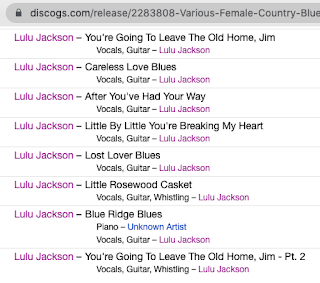
I'm afraid she gets left out on both sides of the recording-industry color line, even by scholars. I just found a blues discography note from a major reference book: "This artist was of African-American ancestry, but her recordings are essentially in the hillbilly idiom and of little blues interest." (Blues and gospel records 1890-1943 (1997), p. 430) Her versions of "Little Rosewood Casket" and "Careless Love Blues" are very nice too, and available on YouTube. Apparently enough of her 78s have been collected to be reissued in compilations like this one found at the discography website, discogs:


 Posts
Posts

