In a rare blogging crossover, it seemed appropriate to write in my other blog today about the Cardinal News article tracing the history of The Crooked Road, Virginia's Heritage Music Trail, and put a link to that "Other Journalism" blog here. That item turned into a personal collection of links and memories about Virginia newspaper websites, the Internet Archive, and a sneaky self-serving plug for a performance by "Bring the Feet," at the November 9 Floyd Contra Dance.
In its opening photo, look for my mandolin waiting on my chair, at the right. I'm in the background, wearing a tan "Dittyville" cap and holding a cup of coffee, talking to Bring the Feet's hammered dulcimer and keyboard virtuoso, Randy Marchany, in a plaid shirt, bottle of orange soda in hand.
More recently, when a Floyd fiddler was putting together a band for the (post-Covid) revived Floyd dance, she asked if I knew anything about New England contra dance music. I admitted to 30 years of dancing and a few occasions of sitting-in with legendary caller Ralph Sweet in Connecticut. More importantly, I tipped her off to Randy's "No Strings" past, and he mentioned that No Strings' bass player was also available. So a band was born... for at least one dance a year. (Actually, this is our fourth for 2024!)
I just realized that the other blog post, while mentioning that Cardinal News reporter Ralph Berrier Jr. is an old-time and bluegrass fiddler, failed to mention his band, The Java Brothers, or his book about the bluegrass music careers of his grandfather and great-uncle, "If Trouble Don't Kill Me." Here's a YouTube copy of a Java Brothers concert ...
I mentioned to one of my journalism classes 15 or so years ago that on the weekends I played "old-time" music. A student responded, "You mean, like, Sinatra?"
No, I said, I meant, like Mike Seeger and perhaps his older half-brother Pete, and the older folks from North Carolina, Virginia and West Virginia that they learned from.
A Facebook discussion earlier this month has sent me down a compulsive-research rabbit hole to a Wikipedia page about "Old-Time Music," which by one of its definitions I still play every Sunday afternoon and Wednesday evening at southwest Virginia jam sessions, and which -- by other definitions -- has fascinated me since I bought my first Pete Seeger and New Lost City Ramblers albums during the 1960s "folk music revival" (Or "The Great Folk Music Scare," as Utah Phillips or someone else called it.) The 20-year-old Wikipedia page has had numerous editorial additions and changes over the years, but its most prominent feature when I got there were a few prominent "citation needed" notices and a somewhat random use of Wikipedia's "references" feature.
My own "primary sources" for learning about "folk music" were big library books, but the phrases "old-time" or "old-timey" music in the 1960s and '70s came to me mostly from LP records and their liner notes, so I've added some of those as references on the Wikipedia page, as well as more recent books I've at least browsed through. A fine CD box-set that came out a few years ago made it very clear that New York's "Friends of Old-Time Music" or "FOTM" used that name as a broad umbrella for "authentic" or "traditional" folk music concerts and records, to avoid confusion with the commercialized singer-songwriter and "interpreter" artists being marketed under the "folk music" banner in the 1960s. The New Yorkers who ran FOTM, unlike the 1920s record companies that used the phrase "old time music," included black guitar players like Mississippi John Hurt under the heading, and older bluegrass bands that had roots in older fiddle and singing styles and perhaps less influence from Nashville record producers ideas of commercial country music. French Canadian and Louisiana Cajun fiddlers also appeared in "old-time" concerts.
Nowadays, "old-time music" is more specifically a fiddle-contest and music convention category to distinguish pre-bluegrass fiddle-and-banjo playing styles in Appalachia, the Ozarks and elsewhere. And today some young players are eager to point out the segregation-area exclusion of black fiddlers and banjo players from early 20th century "old time" records, and so have been reclaiming recognition for the black performance styles that influenced white players, as well as the black origins of the banjo -- an instrument with African antecedents that fell into white hands in the early 19th century and became an international fad after white-impersonators in black makeup created the "Minstrel Show," leading music-instrument factories to mass-produce banjos, and variations on the instrument found roles in Dixieland, Ragtime and Jazz bands, even crossing the Atlantic into Irish music on tenor banjos and British pop-songs accompanied by banjo-ukuleles. Both the banjo and old-time fiddle have separate Wikipedia pages, by the way. I'm staying away from those.
Back to "old-time music"; those early U.S. record companies had separate "race" labels and catalogs, which presented black blues and gospel performers, but the producers appear to have left the old folksongs and fiddle tunes to whites, along with most 20th century banjo playing, all featured under headings including "hillbilly," "mountain music" and "old-time" and "country"... industry distinctions that got even more complicated with the later recording categories "country and Western)," "folk music," "rhythm and blues" and "rock 'n' roll." But that's another story.
The whole Wikipedia old-time-music page seemed to assume the definition of that phrase was written in stone somewhere, but so far I haven't turned over the right rock.
The page was -- and still is -- weak on citations. Its history section gave a lot of weight to a 2021 website article from the state of Washington, about as far as you can get from Appalachia, but this music has been getting around for a couple of centuries or more, and the article itself seems quite good, even mentioning a few promising book titles. It's available online for free here:
If you save the Wikipedia "page" as a PDF file, which I've finally done, it is 13 pages long. (The banjo page is 22; the old-time fiddle page is 9 more.) I've added a few more "old-time" references at various points, but I'm hoping others with both knowledge and a compulsive attitude toward footnotes and coding Wikipedia citation styles will also come to the page's rescue. For now, I've worked more than a half-dozen sources into sections of the page, but my citation style is an inconsistent mess, which I blame on Web cutting-and-pasting while just using a smartphone part of the time... Pasting them into this Blogger editing system will probably create another formatting mess, because I haven't used Blogger much in years, and won't have much time today to come back and clean things up after I hit "Publish."
But here they are:
Huber, Patrick, Linthead Stomp, The Creation of Country Music in the Piedmont South; University of North Carolina Press, 2008
Ritchie, Fiona and Orr, Doug; Wayfaring Strangers The Musical Voyage from Scotland and Ulster to Appalachia, University of North Carolina Press 2021, 2nd ed.
Jamison, Phil; Hoedowns, Reels, and Frolics: Roots and Branches of Southern Appalachian Dance, University of Illinois Press 2015
John Cohen, Mike Seeger, Hally Wood, eds.; Old-time string band songbook, Oak Publications, New York, 1976.
Oh my! The second pandemic year of 2021 is almost over and I haven't added a new page here since December 2019! Here's a lot of catching up in a short space... and a plug for one of my most recent musical discoveries -- not an old video clip like previous entries here, but a podcast that has accumulated something like 300 hours of music and musician interviews, "Get Up In the Cool." Its name, by the way, is from a tune recorded in 1929 by Eck Robertson that makes me think about climbing up to Rocky Knob in Floyd, Va., on a hot summer day. But the podcast is cool in another way. More about that in a minute. First, a couple of my own short smartphone video clips...
I have been playing and listening to music at home and at outdoor jam sessions like that one on the street in Floyd and others in Blacksburg and Radford, Va., after social-distancing rules and vaccination made sharing music possible again. And I have been writing about those things -- but on Facebook and YouTube, not here.
The Floyd Country Store Sunday afternoon jams eventually moved back indoors, as shown above, but as winter approaches, most of the others still have not found homes. Online through 2020 and 2021, I have attended Floyd Country Store, Floyd Handmade Music School and Augusta Heritage Workshop friends' "Zoom" and YouTube events, and finally -- "armed" with two vaccinations, a booster and flu shot, went to the October Augusta Heritage Center Old-Time Retreat for music classes, jams, and even some singing and dancing.
Alas, the week I returned was the start of a month-long cold that made sleeping through the night difficult, but even that was an excuse for musical discovery: I'd heard of, but had not explored, an oldtime fiddle-and-banjo oriented podcast called "Get Up In the Cool," which turned out to be a wonderful way to spend those sleepless nights.
I hope all of these links aren't overwhelming... but at least I feel I'm getting caught up on the latest incarnation of Blogger, including the ability to easily post my YouTube clips and switch between a modern "Compose view" and vintage 20th century "HTML view" of the page I'm writing.
Blog history...
In addition to noticing that I have been neglecting this blog for almost two years, I noticed today that this blog is now 20 years old! Hosted-for-free blogs are like that... people lose interest, regain interest... sometimes they even die. I knew a "serial blogger" called Jimbo -- interested in music and old-time radio -- who died a few years ago, leaving behind probably thousands of pages of his writing on linked-together podcasts and blogs about various 1930s to 1960s radio shows, none of them signed with his real name.
My "Blogger" site started in a classroom at Emerson College, where I taught a freshmen seminar called "Digital Culture: Mediamorphosis," in which students explored media history while learning to use Web tools and Photoshop. The second time I taught the course, one of the students asked why I was having the class write raw HTML code on a campus server to create what I called "weblogs" when there was a new tool called Blogger designed to do the same thing with less work.
The point was that I wanted the class to learn about the page-markup language that was "behind the curtain" at all websites. But I was embarrassed. I had used a couple of other "edit this page" online publishing sites, but at that point Blogger (or "Blogspot") was off my radar, so of course I gave it a try. And this site is the result. Over the years I would create other blogs and websites with Radio Userland, Manila, WordPress, Django, Drupal and more.
But this one -- thanks to Google's ownership -- is the oldest of my "free hosting" sites.
This "Boblog" has evolved over the years from classroom-discussion demo to regular postings, either personal or journalism-class-related (especially 2008-2009 at Radford U, after my Radio Userland host went out of business and while I was in transition to WordPress), and finally reborn as an occasional space for writing about music, while my other sites, stepno.com, jheroes.com and stepno.wordpress.com fill other needs.
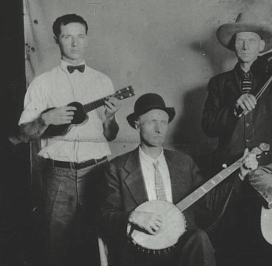
Just discovered both "The Syncopated Times" and -- in passing -- Iver Edwards, ukulele and harmonica player from Galax, Va., in the 1920s, pictured holding what looks like a soprano Martin ukulele in a band photo accompanying this article about vintage recordings:
Discogs says of Edwards, "(1906 - 1960) American old-time musician (harmonica - ukulele). Recorded with Ernest Stoneman on the Victor label c.1927-28."
Now I'm going through Ernest Stoneman records on YouTube listening for telltale ukulele plinking in the background. Easy to loose it in the similar-octave strumming of the autoharp and mandolin, such as that heard on Stoneman's famous Titanic recording...
https://youtu.be/skSUX7pNmSU
Hop Light Ladies may have been one where Iver put down the uke and played the harmonica... https://youtu.be/boE8U3wAUC4
New River Train might have a ukulele in there, mostly smothered by the banjo... https://youtu.be/nQzRrLuWOE0 I'll keep listening.
Success! This article by Rene Rodgers at the Birthplace of Country Music Museum in Bristol answered my question as fast as I could type it into Google. The youngest sister's name was Ada, and there is another picture of her with her ukulele at the Museum website! Alas, the article mentions that she moved on to the Autoharp, and doesn't say much about her ukulele playing, so maybe she only played ukulele during her early days as a musician. That was true for me too, as I moved on to guitar and banjo and mandolin and didn't get back to the ukulele for about 30 years!
It looks like the young women of the Powers family were progressive in other ways too... those bobbed hairdos look pretty modern. But that's a topic for a different kind of blog.
"What tunes do you play at those 'old time music' jam sessions?"
I can generally rattle off a dozen tune names, not that I really play all of the tunes that well... but there are dozens.
Inspiration...
Woody McKenzie, fiddler-host of this week's Wednesday night old-time string band jam session at the Blacksburg Farmers Market had a request for a more complete tune list.... someone running an old-time jam up in New England wanted to be able to link their Facebook page to an authentic tune list from down here and Southwest Virginia.
So I made this blog page to hold whatever lists I can come up with, then he or anyone else can point newcomers, students, or prospective Jam leaders to this page... without necessarily belonging to any of the proliferating Facebook old time music discussion groups.
There is an annual list compiled by one of the local musicians, tracking the popularity of tunes played at the Blacksburg Farmers Market through the year, under a variety of host fiddlers and bands. I hope the gentleman who compiles it can provide it in a format suitable for posting here. An older version from a few years ago was posted to the Crooked Road website, and I'm going to link to that one, if it is still available.
Meanwhile, one of the several bands that lead the Wednesday jam, Happy Hollow String Band, has a website with an impressive playlist of its own, sometimes with chord charts or music for the tunes:
These are all primarily fiddle-centric old-time stringband dance music jams, where everyone plays together, rather than bluegrass jams where participants take turns showing their stuff on lead breaks.
The Independence web page describes its round-robin jam format, where participants take turns either leading or requesting a tune, or sometimes the song. In Floyd and Blacksburg, old-time jams are a little different, in that the lead fiddler or host band choose all or most of the tunes, maybe with a little group discussion or a newcomer's occasional suggestion.
No matter who leads, I tend to have fun anywhere that I can find a few of the tunes on my mandolin, or strum some rhythm chords on it or a banjo ukulele -- when that seems acceptable to the leaders of the group... especially if I'm pretty sure I'm going to be drowned out by other banjos and fiddles.
After singing along with these songs in Paul Brown's workshops at Davis & Elkins College's Augusta Heritage old-time music week, I compulsively went off looking for alternative versions, additional lyrics, and YouTube videos.
Surprises: Session leader Mac Traynham playing rhythm guitar instead of his usual fiddle or banjo, and my arriving in time to catch a seat between Mac and Radford neighbors Linda Frank & Chip Arnold.
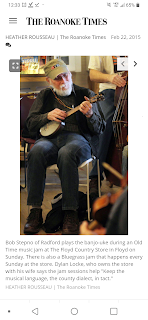
I will send the photographer a note asking permission to "reprint" her close-up of the guy in the NPR cap playing a not-so-traditional banjo ukulele... But since it is property of the Roanoke Times, you might as well just go there and enjoy the whole presentation... if you haven't already been there via the flurry of posts on Facebook.
(note:thisismy first attempt to use anAndroid phone app to post toblogger. I may have to come back and fixthe link, edit embarrassing autocorrect errors, or something.)
This page has been updated many times since 2015, when the announcement of a Blacksburg and New River Valley ukulele get together inspired me to look into the past of ukulele playing in the region's oldtime music communities... My goal was to tell uke players that they didn't need to look for uke-only events, that they would not necessarily be met with scorn and derision at mixed jam sessions in the area, if they were willing to listen, learn some traditional old time string band tunes -- and keep within the style.
As I eventually learned, while they took a minor supporting role, ukes appeared to have been infiltrating old time music recordings in a small way even before John Hopkins' started strumming his triplets on a banjo ukulele loud and clear in the original "Hill Billies," 1926:
Blue Ridge Mountain Blues - The Hill Billies 1926!
"Al Hopkins ... was the leader of his own band called the Hill Billies (also known as the Buckle Busters). The band members consisted of Al Hopkins (piano), John Hopkins (ukulele), Joe Hopkins (guitar), John Rector (banjo), and Tony Alderman (fiddle).
"The Hill Billies had been discovered by Ralph Peer a year earlier and had made some records for Okeh (a forerunner of Columbia). When Ralph Peer asked Al Hopkins the name of his band, Al responded “We ain’t nothing but a bunch of hillbillies from North Carolina and Virginia. You can just call us anything.” Mr. Peer appropriately named them the “Hill Billies”.
I first heard the banjo ukulele played with a fiddle and 5-string banjo in the late 1970s or early 1980s by a more contemporary band, the Horse Flies from Ithaca, N.Y.
Alternating between guitar and banjo uke, depending on the tune, Jeff Claus provided a rock-solid rhythm for the band. I have seen an interview with him somewhere referring to the instrument as "a drum on a stick."
Another contemporary player, John Kelley, headed his web essay and instructional page about the instrument, "Banjo Uke -- the Tommy Gun of old time music!"
However, not all old time Fiddlers will appreciate having a Tommy Gun in their local jam session. It is best to ask, or be very sensitive to icy stares!
This picture turned up in an oldtime radio discussion forum... I had no idea George Gobel started out as an adolescent radio-barn-dance ukulele player during his "Georgie" days! By the 1950s when I first saw him, he was much better known as Ernie Ford's "little bitty buddy" strumming orchestral jazz chords on an oversize Gibson Super 400 guitar along with the jokes and songs on TV.
That big Gibson was almost part of the joke itself, looking out of proportion strapped around the diminutive crewcut Goble. Result: Gibson even named a custom smaller, slimmer jazz guitar after him. (I haven't seen any archival clips showing him going back to the ukulele, but wouldn't be surprised if that didn't turn up in one of Gobel and Ford's TV comedy skits.)
"He was one of the favorites, as well as the youngest performer at the time on WLS' National Barn Dance, a homegrown program which was hugely popular from its inception in 1924 and enduring for over 50 years. George's era started with his debut in 1933. George played the ukulele, which was not a union instrument, thereby avoiding paying union dues."
(Or maybe that was just a punchline in George's transition from mostly-musician to mostly-comedian?
Bud Bennett's first few entries look great, from highlighting the library's music collection to pointing out the existence of County Sales in Floyd, an old-time-music record distributor that he and I both discovered, as Bud says, "Back in the mid-to-late 1970s, far from the New River Valley..." (He links to a Roanoke Times story about County that I missed a couple of weeks ago.)
Running into Bud's blog (while on an Interlibrary Loan visit to the library's website) reminded me that I've been neglecting this blog... even more than I've been neglecting my other five or six blogs and Websites.
The most recent things I've posted about music have been some tweets about a local journalist-musician's (highly recommended) new book, which I'll recommend to Bud by posting them here again:
Speaking of trouble... This week's Roanoke Times headline about an Appalachian music fan with a Radford University connection was less celebratory, but at least it does have a happy ending:
The university is officially yanking the name off one wing its arts and music building, the part that has been called Powell Hall from one end (and Porterfield Hall from the other).
Dean Joe Scartelli, now acting provost, got the Board of Visitors to act quickly (if belatedly), officially dropping the name last week. I hope the university facilities folks and website editors scrub it away soon, without whitewashing the historical fact that the school let the name stand for 43 years. Was the naming of the building a conscious act of "whiteness" in 1967? That was a big year in the Civil Rights movement, with an important Virginia case before the Supreme Court, the ironically named "Loving v. Virginia," and a future publisher of the Roanoke Times and Radford board member -- covering the "Mississippi Burning" case for The New York Times.
For anyone not familiar with RU and its arts facilities, here's one last coincidence or bit of irony: While plans to renovate Porterfield/Powell were on hold, the school built a fine new performing arts center next door and named it for Douglas & Beatrice Covington.
"“Breakfast in the Blue Ridge” was a popular syndicated country music program featuring “National Barn Dance” performers Lulubelle and Scotty. In this post and the next, we hear two sides of the Audition disc for the series, circulated to station programmers and advertisers."
I like the way Rand's Esoteric OTR site even gives you the label of the transcription disc for a programs... In this case the "program" is actually a promotion for the series, interviewing Lulubelle and Scotty about their new morning show... a nice behind-the-scenes look (or listen).
(With Dec. 26 update, appropriately enough.) While I was still in a half-asleep Wednesday-morning fog, the clock radio and WVTF cut through with a short piece about the between-holidays tradition of "Breaking Up Christmas" music parties, and a pointer to http://folklifefieldnotes.org, a Virginia Folklife Program website I hadn't run into before.
I didn't see the item itself on the Morning Edition rundown or WVTF sites. It ran a bit incongruously somewhere around the story about Larry McMurtry's "Literary Life", an interview with Liz Smith recalling "when gossip columns ruled," the news that Arnold Stang has died, and Frank Deford's speculation that multi-product spokesmodel Peyton Manning learned comedic timing from football. (Not the "hardest" of news this time of year.)
Update -- WVTF played the spot again on Saturday morning's Weekend VA, with this lead-in: "When Christmas is over, the fun is just getting started for many in Southern Appalachia. Virginia State Folklorist Jon Lohman has the story behind 'Breaking up Christmas,' a little-known tradition that takes place the week between Christmas and New Year's Day."
Searching for that passage helped me find the program -- and a new resource to bookmark. The segment turned out to be distributed via PRX.org, the Public Radio Exchange, "a growing social network and community of listeners, producers, and stations collaborating to reshape public radio."
The organization has a blog, RSS feeds, Twitter feeds, and services for listeners as well as producers and stations. Cool... but back to Breaking Up Christmas...
The first time I heard the program, I suspected it might be by Paul Brown, but didn't think it was his voice on the item, although I was still half asleep. Paul's the banjo-pickin' NPR news guy who did a documentary on Breaking Up Christmas a dozen years ago (as mentioned here). I think he was the first person I heard play the tune by that name, too, when he was my banjo teacher for a week or two about 30 years ago (photo at right). I couldn't find a link to that documentary of his, but did discover that he's donated his archives to my alma mater down in Chapel Hill. Cool!
In my Googling around the subject, I also found a UNC educational resource for school teachers interested in using the Breaking Up Christmas tradition (and Paul's documentary) to get students writing about their own family or cultural traditions.
The Song of the Mountains page for its 2006 Breakin' Up Christmas party mentions Paul's project and includes this enigmatic lyric:
Hoo-ray Jake and Hoo-ray John, Breakin' Up Christmas all night long.
Way back yonder a long time ago The old folks danced the do-si-do.
Way down yonder alongside the creek I seen Santy Claus washin' his feet.
Santa Claus come, done and gone, Breakin' Up Christmas right along.
I also discovered the CD of Paul's program through a fan of his in Japan, although he or she doesn't seem to police the spam on that page much. Do Breaking Up Christmas and Viagra ads go together? Who knew?
One result of all this impromptu research: I headed up&down to Floyd to see if the CountryStore had a copy of the record. (It did; I bought a couple of copies -- one for me, one for Christmas giving.)
Video footnotes c/o YouTube: Two great versions of the tune (you'll have to wait a minute for the video on the second one... from the upper Appalachians around Ithaca)
(I first heard the Horse Flies at that same Pinewoods summer camp I met Paul! Time sure flies, and the Web pulls it together... web... flies... Horse Flies... must be a thread there.)
More update: House parties, jam sessions, folk music, public radio, Facebook, Twitter, YouTube, Blip.tv, make an interesting cross-section of old and new media "social networking." The PRX organization I discovered in my online travels this week is another manifestation... and it has it's own online video item to explain what it's all about. Enjoy:
While this was a more general blog at first, since 2009, Boblog has been for occasional writing about music, part of trying to differentiate my web writing spaces. My other blogs are JHeroes (old-time radio's portrayal of journalists) & Other Journalism, a general-purpose writerly blog, successor to stepno.com/oldblog. When I was teaching, they all sometimes served other purposes.
I have worked for two newspapers (one full time for 11 years), several magazines, four software companies, and six colleges and universities, counting part-time, freelance and student jobs. See stepno.com.




 The first time I heard the program, I suspected it might be by


 Posts
Posts

