I thought I'd written about Frank Crumit before, as a prominent vocalist and ukulele player a century ago... but it looks the site "OldTimeBlues" beat me to it, so here's what they have to say, with a picture of Crumit holding a tiple, and two recordings of his singing with other instruments.
Another YouTube user has built a 30-song Frank Crumit playlist, so I'll be listening to his great old-time songs -- and for the jangly sound of the tiple! (What's a tiple?)
I think "Ukulele Lady" was the first Crumit classic I ever heard... and I think my mother sang "What Kind of Noise..." On both, it sounds like Frank and accompanists used uke, maybe a mandolin-family instrument, and other backing instruments, but I don't hear a tiple... and the image with the second video looks to be another member of the ukulele family, an eight-string "taropatch."
Tuesday, February 04, 2025
Another Tiple player from the 1920s!


Wednesday, December 18, 2024
Tiple and mandolin, together at last
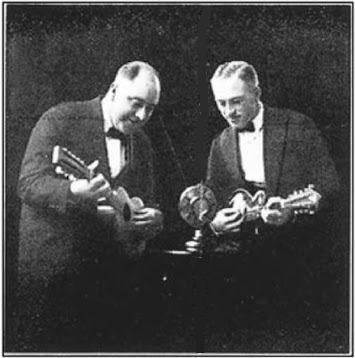
The Golden Melody Boys, who I've read about at Discogs and OldTimeBlues, were also The Georgia Melody Boys -- perhaps a case of using different names for different record labels, since they were from Cedar Rapids, Iowa, not Georgia. I'm glad that 78 RPM record collectors have preserved some of their recordings.. and have even put them on youtube.
Here are a few, starting with an embedded video of the most recent I've heard...
(Yes, I've replaced the strings since writing the first draft of this. Added that YouTube playlist too.)
Saturday, January 15, 2022
When the blues hit the mountains...
Oldtime music crossover...
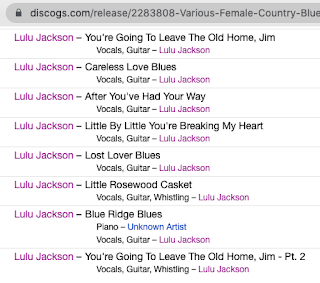
While looking for the words to a less-often-heard "shindig in the barn" verse to "Blue Ridge Mountain Blues," I found several "discography" lists, including the two recordings as "Blue Ridge Blues" below... George Reneau's was apparently the first recording of the song. And Lulu Jackson's version gets left out of some of the "country music" or "oldtime music" lists, maybe because it crossed boundaries, but I'd love to read a history about how she wound up recording the song! Her "recitation" of the "There'll be a shindig in the barn" verse is, well, very special.


I'm afraid she gets left out on both sides of the recording-industry color line, even by scholars. I just found a blues discography note from a major reference book: "This artist was of African-American ancestry, but her recordings are essentially in the hillbilly idiom and of little blues interest." (Blues and gospel records 1890-1943 (1997), p. 430) Her versions of "Little Rosewood Casket" and "Careless Love Blues" are very nice too, and available on YouTube. Apparently enough of her 78s have been collected to be reissued in compilations like this one found at the discography website, discogs:
Monday, December 30, 2019
Another vintage mountain ukulele player
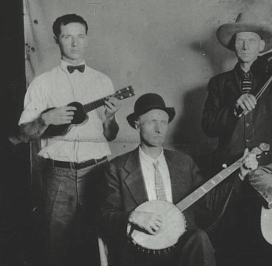
https://syncopatedtimes.com/fred-hager-and-the-birth-of-country-music/?fbclid=IwAR0MxtZjyRCAoleqof-W7AUnmx_bUmYGn3ZKy9xsUDSXLZvksBY9Lrv6BFI
Now I'm going through Ernest Stoneman records on YouTube listening for telltale ukulele plinking in the background. Easy to loose it in the similar-octave strumming of the autoharp and mandolin, such as that heard on Stoneman's famous Titanic recording...
https://youtu.be/skSUX7pNmSU
Hop Light Ladies may have been one where Iver put down the uke and played the harmonica...
https://youtu.be/boE8U3wAUC4
New River Train might have a ukulele in there, mostly smothered by the banjo...
https://youtu.be/nQzRrLuWOE0
I'll keep listening.
Monday, November 19, 2018
1924 mountain ukulele?
Tuesday, May 09, 2017
Four Virginians with a Tiple
https://youtu.be/RInuYDVVIlU
https://youtu.be/yypYMo6Zm80
https://youtu.be/VOxIZ9FMOxE
https://youtu.be/j0P82u-R42E
https://youtu.be/w0d7XNl8KoY
Fiddle – Richard Bigger
Guitar – Fred Richards
Vocals and Guitar – Elvin Bigger
Monday, April 27, 2015
It's a tiple
The Martin guitar company made tiples for 50 years or more, using the same combinations of woods they used for guitars -- all mahogany models (15 or 17), or mahogany or rosewood tiples with spruce tops (18 or 28) -- but I see no immediate threat of a revival in tiple playing... However, something inspired the Ohana ukulele company to produce this version. In Colombia there is a larger instrument by the same name, with some marvelous players. Other Latin American countries use the same word to describe somewhat different instruments. YouTube may find you examples. Here's mine:
Martin-style tiples were also made by companies from Regal and Harmony to D'Angelico. I haven't retrieved a copy of Mike Longworth's Martin Guitar history recently, but the folks at Mandolin Brothers did -- when they had a tiple for sale some years ago -- and said, "The Martin Tiple, Longworth says, was designed around 1920 from a somewhat larger prototype imported from Argentina by Mr. William J. Smith who owned a New York City music company that bore his name." They also included more details about the specific model, a rosewood-and-spruce T-28. Various folks at Wikipedia have been chronicling a the instruments called "tiple" in the Spanish-speaking world. I've even added some of the information there on the "tiple NorteAmericano."
For a couple of years while the bookmarking service "Delicious" was in regular operation, I saved almost 50 bookmarks to Web pages about the instrument (including parts of the blog http://martintiple.blogspot.com/) and YouTube videos of tiple players including the Spirits of Rhythm, the Cats & the Fiddle, Ed Askew, and more (at del.icio.us/bstepno/tiple) but the service has changed hands and has gone in and out of operation, while the internet archive preserved only a few of the links. So I have added a few more links below and will write other blog posts about interesting tiples now and then.
Repairman Jake Wildwood in Vermont has posted numerous blog essays on tiples he has patched up and played over the years, including tiples made by Martin, Regal, Harmony and more -- and sometimes he includes audio or video clips.
https://youtu.be/SEQ9Sz0UCl8
The tuning is similar to a uke (or a guitar capoed at the fifth fret), but in four courses --
Gg-cCc-eEe-aa -- with the big letters indicating strings tuned an octave lower than the ones they are paired or tripled up with.
By the way, the second tune I play on that YouTube demo is one of my favorites, "I wish I could shimmy like my sister Kate," using a chord progression folks of a certain age will recognize as pretty similar to Country Joe MacDonald's "Feel like I'm fixin' to die rag."
And a reissue of recordings by "Big Boy" Teddy Edwards, Chicago blues singer who recorded some solo tiple-accompanied vocals in the 1930s:
https://thedocumentrecordsstore.com/product/DOCD-5440/
Here's a sample of Edwards' style on YouTube: https://youtu.be/LL5_NE0cKec
Finally, here is the only classical piece of music I've heard orchestrated for an ensemble that includes a tiple: Gymnopédie No. 1 - Eric Satie, arranged and performed by Russick Smith for cello, double bass, mandolin, tiple, resonator guitar, and banjo: https://youtu.be/3rRU6Zs4kIw
Wednesday, February 25, 2015
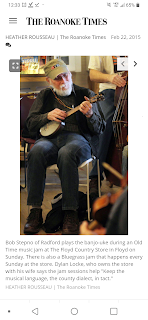
Speaking the old-time language
It was the first Sunday that I'd made it to the jam in weeks of bad weather and/or bad timing. She caught me playing the Firefly banjo-ukulele I've already written about here.

Wednesday, January 28, 2015
In search of the mountain ukulele
My Firefly & Clawhammer Banjo-uke
First flights with Firefly banjo-uke

This picture turned up in an oldtime radio discussion forum... I had no idea George Gobel started out as an adolescent radio-barn-dance ukulele player during his "Georgie" days! By the 1950s when I first saw him, he was much better known as Ernie Ford's "little bitty buddy" strumming orchestral jazz chords on an oversize Gibson Super 400 guitar along with the jokes and songs on TV.
That big Gibson was almost part of the joke itself, looking out of proportion strapped around the diminutive crewcut Goble. Result: Gibson even named a custom smaller, slimmer jazz guitar after him. (I haven't seen any archival clips showing him going back to the ukulele, but wouldn't be surprised if that didn't turn up in one of Gobel and Ford's TV comedy skits.)
But that's not all... Continued research (OK, a five-minute browse with Google) led to this fascinating claim about the ukulele as a way to dodge musicians' union dues:
"He was one of the favorites, as well as the youngest performer at the time on WLS' National Barn Dance, a homegrown program which was hugely popular from its inception in 1924 and enduring for over 50 years. George's era started with his debut in 1933. George played the ukulele, which was not a union instrument, thereby avoiding paying union dues."(Or maybe that was just a punchline in George's transition from mostly-musician to mostly-comedian?
Saturday, November 08, 2014
Accidental Ukulele
This fall I decided to pass up the T-shirt stand and contribute to the support of LEAF by buying some raffle tickets instead. The decision was a very lucky one...

Don't worry, I didn't think my singing would add anything to the ukulele demo. (Incidentally, this is my first experience with a "low-G" tenor ukulele, which seemed especially well suited to a slight adaptation of the guitar arrangement of this tune.) If you'd like to sing along, I found the "Deep River Blues" lyrics over at the Digital Tradition collection at the Mudcat Cafe, a great resource for folksong fans.
Jay himself recorded a few tunes with the uke and put them on his website. They give a much better indication of the range of this lovely instrument. They also may have been recorded with a much better microphone -- or the uke's built-in pickup, which I didn't even notice until I'd owned it for a few days. (Since that page of his was for the raffle -- which is now over -- I don't know how long he'll keep it around.)
I found out later he had posted photos of the uke under construction, and they are still there.
Unfortunately, all I had handy was my MacBook with its built-in camera and microphone, which I figured would be fine a test drive at the uploading process. YouTube didn't want to accept the original file, so I uploaded it directly with Blogger -- which may only have a "Flash" player for videos, making the clip invisible to iPads and other discerning devices. Since then, I've tried some file-conversion software, which appeared to solve YouTube's problem with accepting the original file. Using Blogger's "insert from YouTube" setting still produces a rather small display window on this page and still seems to only offer a Flash video player, but the quality of the video itself seems better than the original. I've linked the still image above to YouTube for a larger-format display.
For any Web production students curious about my video problems, I've included both versions below. After years of mostly using WordPress blogs, I clearly have to refresh my knowledge of the current version of Blogger! But playing the ukulele is much more fun. If your device won't play the video in this window, just follow this link to launch the video in YouTube itself: http://youtu.be/0L9PyUTHqlU
Earlier upload (Google/Blogger video player):
Saturday, March 08, 2014
Yes, it's a ukulele -- and a banjo

My "Firefly" banjo-uke raises a few eyebrows around old-time Appalachian music sessions, so I thought I'd put some links here... And maybe a YouTube video of myself when I get around to it. (This is also my first attempt at posting to this old blogger blog from an iPad, so some editing and correction of links and players for other folks' YouTube videos may be necessary.)
It has four nylon strings (like a uke) and a drum-head (like a banjo). It also tunes uke style, g-C-E-a, with the two outside strings being the highest pitches. The high "g" is the string closest to the thumb, which is also true of the five-string banjo. That coincidence has inspired me to experiment with playing in a "claw hammer" oldtime banjo style, as well as more traditional uke strumming and picking styles.
In addition to playing it in Radford, Blacksburg and Floyd, I've inflicted it on that old gang of mine in Connecticut in December, strumming along on sea chanteys and drinking songs in the pub:
Http://thejovialcrew.com/?page_id=1475
The Firefly is a modern design from a Massachusetts company called http://MagicFluke.com -- I bought mine from http://MimsUkes.com in Floyd, Va., so that I could try it first. I like it because it is incredibly light and, with an extra-long neck, can be adapted to play in more keys, using a capo for some tunes in the keys of A and D.
Here's "Redhaired Boy," usually played in A on fiddle, but sometimes sung as the Irish ditty "Little Beggarman" in other keys. I have experimented with it in both key of C and key of D fingerings on the banjo ukulele.
The first time I saw the banjo uke merging with oldtime tunes was 30-some years ago, in the hands of Jeff Claus of the Horseflies, providing a driving rhythm for the band's neo-primitive bug music. More recent example: http://www.youtube.com/watch?v=FaVFzdroXKg
There's no Firefly-Horseflies connection, as far as I know, but stranger things have happened. TheFirefly's lightness I mentioned is the result of MagicFluke's buying the "drum" shell and its synthetic head already molded or cemented together. There are no metal mounting brackets (originally needed to adjust the tension of humidity-sensitive natural skin banjoheads) and no wood and metal resonator like some 1920s models. As a result I can head for a jam session carrying a guitar, a mandolin, and the Firefly without needing a cart or pack animal, or feeling like one. And it is so much fun that I often wind up leaving the guitar at home.
Curiously, the razzmatazz strumming style banjo-uke (a.k.a. banjolele) has quite a following in the U.K. (No U.K./uke pun intended) because of a 1930s-40s comedian, singer, actor and pop star named George Formby, who never quite caught on in the States. The George Formby Society (http://www.georgeformby.co.uk) keeps his legend alive and active over there (http://www.georgeformby.co.uk/news/morecambe/130214.html).
For a frighteningly modern development, explore the phenomenon called "chap-hop."
Thursday, December 25, 2008
Defiantly soothing news
Teaching news writing, I've seen "defiantly" before as a typo for "definitely," but combining it with "soothing" might be ironic juxtaposition. I'm not 100 percent sure what's going on in the item below...
If there's any real threat of people calling a genre of sound-wallpaper "stepno music" (combining "techno" and "dubstep") I'll feel compelled to listen once in a while. The idea was raised in the "comment" thread on this Top 20 list:
Little White Earbuds -- LWE’s Top 20 Singles of 2008 (Part 1):
"If there was a running meme of the techno-dubstep hybrid in 2008, “Circling” was the first to organically complete the cycle. Appleblim and Peverelist created a track with both the sensual space of Berlin with all the tickling Bristol bass. Defiantly soothing, “Circling” is the perfect twist to the cartoonishly aggressive dubstep scene."
Thanks for the musical education... It's nice to have some new music in my ears on Christmas, much as I love Bing. (I don't think the "Berlin" mentioned above was Irving.)
As an admitted ukulele player with ethnomusicological tendencies, whose personal musical goal for a few years has been to successfully merge "I wish I could shimmy like my" Sister Kate with Chuck Berry's "Sweet Little Sixteen," I have to admit I found "Circling" more fun to listen to than many of the 15 items ahead of it on Buds' top-20 list.
The touch of synth rainstick and rainforest sounds is soothing, in a defiant sort of way.
Feliz navidad and happy Chanukkah.
PS If you want one more new audio experience for the new year, a quick search for "ukulele" and "Hanukkah" found this.


 Posts
Posts

