Sunday, February 26, 2017

Oldtime Songs as Oldtime Radio Drama

Ever wish one of your favorite old songs could go on for a half hour? Or want to know the story-behind-the-story of a ballad? Would you mind if the stretch added a new cause to a historic Virginia train wreck, or made the South Pacific the new setting of a song that had migrated from Scotland to North Carolina?

While I've been using this blog for intermittent posts about folk, blues and old-time stringband music, in my other incarnation over at http://jheroes.com ("Newspaper Heroes on the Air") I write about the portrayal of journalists in the radio dramatic series of the thirty-some years before television killed radio drama as a major element in American popular culture.

Here's a crossover between my blogs: One of the radio dramatic programs that sometimes had journalist characters in its plots also had a "folk song revival" theme in a group of 1950s episodes based on traditional ballads and blues. Posting a journalism-related episode of "Suspense" to jheroes reminded me that a few of its tales of death and disaster came from old songs.

"Suspense" was a highly rated and expertly produced series for 20 years, specializing in tension,  adventure and murder, from "Othello" to "Frankenstein" and "Leinengen vs. the Ants." As a result, the Old Time Radio Researchers Group has a substantial collection of episodes (more than 900 of them!), which it shares with the public through the Internet Archive (archive.org).

Below are direct links to the folk-song episodes I've noticed, produced and directed by Elliott Lewis, with scripts by several writers, including Morton Fine and David Friedkin, according to radio historian J. David Goldin's listings and announcements during the programs. Click to download the MP3s or open them in your browser. 

The Wreck of the Old 97 (March 17, 1952) 

Frankie and Johnny (May 5, 1952) 

My True Love's Hair (Oct. 19, 1953)

Frankie and Johnny (Feb. 3, 1957)


Tom Dooley (March 30, 1953)

Tom Dooley (Dec. 7, 1958)

--------------------------

While it's not folksong-based, music fans also might be intrigued by the vaudeville title "Never Follow a Banjo Act," with Ethel Merman.

I'm particularly fascinated by the fact that "Suspense" put its dramatization of "Tom Dooley" on the radio years before The Kingston Trio's arrangement of the song became a national hit. A version of the song had been recorded as early as 1929 (by Grayson and Whitter), but re-entered the "folk song revival" consciousness when collected by folklorists Frank & Anne Warner from Frank Proffitt in North Carolina in 1938 and published in John & Alan Lomax's book Folksong U.S.A. in 1947.  It was recorded by Warner in 1952 (and eventually by Proffitt on Folk Legacy Records in 1962).

The Suspense radioplay based on the song was first heard in 1953, then recast and broadcast in 1958, using that year's Kingston Trio hit recording.  According to J. David Goldin's "RadioGoldindex" of "Suspense" episode information, Harry Stanton was the vocalist on the 1952 broadcasts of both "Tom Dooley" and "Old 97."

Louise Louis was vocalist on "Barbara Allen." Big band singing stars who crossed over to film and television were also part of the casts: Dinah Shore played the lead and sang the song in "Frankie and Johnny" and Rosemary Clooney was listed among the cast for "Saint James Infirmary." Margaret Whiting was Frankie in the 1957 broadcast.

The story "My True Love's Hair," uses the song "Dark Is the Color of My True Love's Hair," popular among American folksong singers in the 1950s. However, the radio play adds a murder to the simple song of lovers parting that was heard in North Carolina and published in 1917 as part of English Folksongs Collected in the Southern Appalachians by Olive Dame Campbell and Cecil J. Sharp. Verses of the song are sung by Ernest Newton during the broadcast, and phrases from the lyric are worked into the dialogue, spoken by lead actor Jeff Chandler -- but the setting is far from Appalachia or the British Isles. Radio historian J. David Goldin calls the tale "A spectacularly beautiful and well-written sound portrait of the South Seas." In contrast, the version collected by Campbell and Sharp mentions the river Clyde in Scotland. The song had been commercially recorded a half-dozen times before the Suspense broadcast, first with a new melody by the Kentucky composer and folk singer John Jacob Niles in 1941, and later by Burl Ives, Jean Ritchie and others

According to Goldin's logs, along with his "Tom Dooley" performance, Harry Stanton was among the cast members for a different radio series' musical drama, the Lux Radio production of "Dixie," an hour-long, thoroughly  fictionalized and whitewashed dramatization of the life of minstrel banjo pioneer Dan Emmett. Based on the movie by the same name and broadcast Dec. 20, 1943, the radioplay has the film's star Bing Crosby in the lead. You can almost smell the blackface burnt cork in one of Hollywood's regrettable acts of nostalgia for the days of on-stage racism and a romanticized 1800s Southland. Newton and Stanton both appeared in other Lux productions.

Instead of admitting that imitating black musicians was the inspiration for white minstrels' "blacking up," the story has the absurd excuse of Emmett and another performer originally using blackface makeup to cover up black eyes and bruises from a fight. (Crosby vs. Barry Sullivan as "Mr. Bones.") Their act is mostly joke-telling with "Amos and Andy" accents. Minstrel-style music is barely heard amidst the Crosby crooning. And, no, Dan Emmett didn't write the Crosby classic "Sunday, Monday or Always" that opens the program. In fact, some researchers believe the title song "Dixie"  actually came to Emmett from the Snowdens, a black family in Ohio.

Monday, August 29, 2016

Oldtime Music Beyond Facebook

A friend just posted a request for more old-time and bluegrass music festival posts in a Facebook group... one of many that try to meet that need.

My reply... (Also an excuse to try updating this blog with a copy of a Facebook post, using only my phone. Until I go through one at a time to turn them into hyperlinks, link addresses may require copying and pasting, not just clicking. Hard to tell on this tiny screen.)

Feeling your pain... I just don't trust Facebook for reliable calendar-type information. So much duplication, but so much confusion about when and how things appear in groups, notices & on your/my timeline!

But even the "open web" calendars by non-profits have holes in them. Not sure Hoppin John Convention http://hoppinjohn.org (or the 50-band Shakori Hills concert/fest at same venue a month later?) is on any of the NC lists below.... as well as being exempt for the Va and WVa lists!

Here are a few items from my jumbled venue,  event and organization bookmark list. But I don't envy any of the list keepers!
:-(

Va.

https://www.myswva.org/tcr

http://FloydCountryStore.com

http://www.virginia.org/directory/Events/?regionid=8&categories=91&start=8-29-2016&end=9-12-2016

West Va.

Http://mountainmusictrail.com

N.C.

http://hoppinjohn.org

http://www.blueridgemusicnc.com/find-music/all-events

https://nationalfolkfestival.com

https://www.pinecone.org

Tenn.

 https://www.tnvacation.com/vendors/appalachian-cultural-music-association-mountain-music-museum

http://www.etsu.edu/cas/das/bluegrass/

 http://festivalnet.com/music_festivals.html/Tennessee-music-festivals

That last one is an membership & ad-supported national monster that I just stumbled on...

But it it doesn't miss http://Louiebluie.org  Sept. 24, even if it doesn't have an obvious link to the event's own site!

Friday, August 07, 2015

Oldtime Country Music at archive.org

The Internet Archive may not be the first place you look for old-time country sounds, but some old-time radio and 78 rpm record collectors have digitized an amazing amount of 20th century American  culture.

I'll come back and edit this, but wanted to put a few links out where new old-time music friends can find them today.

Sorry if there are spelling errors, and if you have to cut and paste the links into a browser. The first draft of this was done with my left thumb on a smartphone during a singing class at Augusta Heritage Center. (https://augustaheritagecenter.org)

Most of these are radio. Some are 1950s TV. The Delmore brothers sell their gospel song book, the Willis Brothers  swing "Hillbilly Heaven." All Star Western Theatre combines accordion and guitar western harmonizing with short dramatic productions with cowboy movie stars of the forties. Pat Daniels Hillbilly Boys sold Hillbilly flour with Texas Swing, while Hank Williams sold Mother's Best flour with his country blues. Plenty here to explore.

https://archive.org/details/otr_countrymusictime

https://archive.org/details/OTRR_Delmore_Brothers_Singles

https://archive.org/details/OTRR_Certified_Delmore_Brothers

https://archive.org/details/GrandOldOpry-28april1956

https://archive.org/details/HankPennyHisRadioCowboys-01-10

https://archive.org/details/charlottecountry00holt Booklet PDF

https://archive.org/details/RanchParty1957

https://archive.org/details/0029OldTimeRadioReunion

https://archive.org/details/otr_countrymusictime

https://archive.org/details/OTRR_Mothers_Best_Flour_Singles

https://archive.org/details/OTRR_The_Hillbilly_Boys_Singles (Pat O'Daniel & the...), 74 episodes

https://archive.org/details/OTRR_All_Star_Western_Theatre_Singles

https://archive.org/details/otr_geneautry

https://archive.org/details/RoyRogers01-10

Tuesday, August 04, 2015

Some songs from Augusta

After singing along with these songs in Paul Brown's workshops at Davis & Elkins College's Augusta Heritage old-time music week,  I compulsively went off looking for alternative versions, additional lyrics,  and YouTube videos.

Cumberland Gap
https://youtu.be/t4Jawe-M2yc

Deadheads and suckers
https://youtu.be/N1byRXjV2LU

Tempy Roll Down Your Bangs
http://mudcat.org/thread.cfm?threadid=18014

Railroad Bill (with brakemans vest, nancy hanks verse)
http://pancocojams.blogspot.com/2013/09/riley-puckett-railroad-bill-information.html

Trouble in Mind
https://youtu.be/8a54Nz6aYYY

My home is across the blue ridge mountains
https://youtu.be/Z7i1CQv74aE

Walking in my sleep
https://youtu.be/LoRFJd47rtU

Poor Ellen Smith
murder case, Winston Salem c.1897

http://www.murderbygaslight.com/2010/07/poor-ellen-smith.html

http://mobile.nytimes.com/2009/02/02/us/02land.html?pagewanted=all&referrer=

Monday, April 27, 2015

It's a tiple

I finally made a short video of my other ukulele-family instrument, a 10-string "tiple." I'd like to think it was by popular request... a request usually phrased as "What the hell is that thing?"

The Martin guitar company made tiples for 50 years or more, using the same combinations of woods they used for guitars -- all mahogany models (15 or 17), or mahogany or rosewood tiples with spruce tops (18 or 28) -- but I see no immediate threat of a revival in tiple playing... However, something inspired the Ohana ukulele company to produce this version. In Colombia there is a larger instrument by the same name, with some marvelous players. Other Latin American countries use the same word to describe somewhat different instruments. YouTube may find you examples. Here's mine:


(Video oops... for some reason, when I talk about the tuning and play the four open notes, I say "from top to bottom" while picking the strings from bottom to top! Sorry if that confuses anyone. More on tuning below.)

Martin-style tiples were also made by companies from Regal and Harmony to D'Angelico. I haven't retrieved a copy of Mike Longworth's Martin Guitar history recently, but the folks at Mandolin Brothers did -- when they had a tiple for sale some years ago -- and said, "The Martin Tiple, Longworth says, was designed around 1920 from a somewhat larger prototype imported from Argentina by Mr. William J. Smith who owned a New York City music company that bore his name." They also included more details about the specific model, a rosewood-and-spruce T-28. Various folks at Wikipedia have been chronicling a the instruments called "tiple" in the Spanish-speaking world. I've even added some of the information there on the "tiple NorteAmericano." 

For a couple of years while the bookmarking service "Delicious" was in regular operation, I saved almost 50 bookmarks to Web pages about the instrument (including parts of the blog http://martintiple.blogspot.com/) and YouTube videos of tiple players including the Spirits of Rhythm, the Cats & the Fiddle, Ed Askew, and more (at del.icio.us/bstepno/tiple) but the service has changed hands and has gone in and out of operation, while the internet archive preserved only a few of the links. So I have added a few more links below and will write other blog posts about interesting tiples now and then.

Repairman Jake Wildwood in Vermont has posted numerous blog essays on tiples he has patched up and played over the years, including tiples made by Martin, Regal, Harmony and more -- and sometimes he includes audio or video clips. 

Here's my favorite tiple video... How "The Cats and the Fiddle" kept their instruments in tune with all the flipping and twirling in this movie amazes me. Perhaps Ohana needs to study 1930s Martins a bit more. 


https://youtu.be/SEQ9Sz0UCl8

The tuning is similar to a uke (or a guitar capoed at the fifth fret), but in four courses --
Gg-cCc-eEe-aa -- with the big letters indicating strings tuned an octave lower than the ones they are paired or tripled up with.

By the way, the second tune I play on that YouTube demo is one of my favorites, "I wish I could shimmy like my sister Kate," using a chord progression folks of a certain age will recognize as pretty similar to Country Joe MacDonald's "Feel like I'm fixin' to die rag."

So far the high point of my tiplista career was in 2015 introducing ukulele-playing songwriter Nellie McKay (be still my heart.) to the instrument in the Abingdon, Va., Barter Theater lobby after a Mountain Stage live-concert recording session. I think I have a picture of her playing it around here somewhere. With luck I'll find it and add it here. With even more luck, I'll get to see her again before long. I haven't seen any evidence that Nellie has acquired a tiple of her own, but YouTube does have a clip of her playing a more conventional 8-string uke, linked here for comparison with the 10-string tiple sound.

In 2017 I added a few links to a Southern Virginia band with a rhythm tiple in a separate post here:


Here's another knowledgeable post about tiples, with some interesting discussion:

http://www.homebrewedmusic.com/2013/02/08/ever-heard-of-a-martin-tiple

And a reissue of recordings by "Big Boy" Teddy Edwards, Chicago blues singer who recorded some solo tiple-accompanied vocals in the 1930s:
https://thedocumentrecordsstore.com/product/DOCD-5440/

Here's a sample of Edwards' style on YouTube: https://youtu.be/LL5_NE0cKec

A couple of decades later, Timmie Rogers recorded a couple of TV scenes with a tiple that probably has been seen and heard by thousands, maybe millions, thanks to years of syndicated reruns of "Sanford and Son," where he played Smiley Rogers, a friend and singing duet partner of Fred Sanford (Redd Foxx)... 


https://youtu.be/sHlNHGb1oAc

Finally, here is the only classical piece of music I've heard orchestrated for an ensemble that includes a tiple: GymnopĂ©die No. 1 - Eric Satie, arranged and performed by Russick Smith for cello, double bass, mandolin, tiple, resonator guitar, and banjo: https://youtu.be/3rRU6Zs4kIw


Wednesday, February 25, 2015

Speaking the old-time language

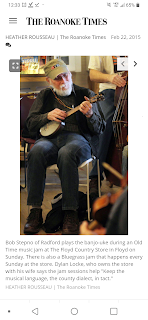
Heather Rousseau, a new photo journalist at the Roanoke Times, dove right into local culture with a photo and video story from the Sunday afternoon old-time jam at the Floyd Country Store

It was the first Sunday that I'd made it to the jam in weeks of bad weather and/or bad timing. She caught me playing the Firefly banjo-ukulele I've already written about here.

Surprises: Session leader Mac Traynham playing rhythm guitar instead of his usual fiddle or banjo, and my arriving in time to catch a seat between Mac and Radford neighbors Linda Frank & Chip Arnold.


I will send the photographer a note asking permission to "reprint" her close-up of the guy in the NPR cap playing a not-so-traditional banjo ukulele... But since it is property of the Roanoke Times, you might as well just go there and enjoy the whole presentation... if you haven't already been there via the flurry of posts on Facebook.


(note: this is my first attempt to use an Android phone app to post to blogger. I may have to come back and fix the link, edit embarrassing autocorrect errors, or something.)

Wednesday, January 28, 2015

In search of the mountain ukulele

This page has been updated many times since 2015, when the announcement of a Blacksburg and New River Valley ukulele get together inspired me to look into the past of ukulele playing in the region's oldtime music communities... My goal was to tell uke players that they didn't need to look for uke-only events, that they would not necessarily be met with scorn and derision at mixed jam sessions in the area, if they were willing to listen, learn some traditional old time string band tunes -- and keep within the style.
As I eventually learned, while they took a minor supporting role, ukes appeared to have been infiltrating old time music recordings in a small way even before John Hopkins' started strumming his triplets on a banjo ukulele loud and clear in the original "Hill Billies," 1926:


Blue Ridge Mountain Blues - The Hill Billies 1926!
Background from...
https://web.archive.org/web/20151005202634/http://www.oldtimemusic.com/FHOFBowman.html
"Al Hopkins ... was the leader of his own band called the Hill Billies (also known as the Buckle Busters). The band members consisted of Al Hopkins (piano), John Hopkins (ukulele), Joe Hopkins (guitar), John Rector (banjo), and Tony Alderman (fiddle).
"The Hill Billies had been discovered by Ralph Peer a year earlier and had made some records for Okeh (a forerunner of Columbia). When Ralph Peer asked Al Hopkins the name of his band, Al responded “We ain’t nothing but a bunch of hillbillies from North Carolina and Virginia. You can just call us anything.” Mr. Peer appropriately named them the “Hill Billies”.
http://jopiepopie.blogspot.com/2013/06/blue-ridge-mountain-blues-1924.html
More Hillbillies and Buckle Busters tunes...

(I could be wrong. You have to listen hard to be sure the uke is there, especially if the 5-string is playing rhythm on high notes)
Other Oldtime uke players...
Ada Powers (notice her central position, with uke,  in this great old fiddlers convention photo)
The Four Virginians (with a uke-tuned 10-string tiple)
Price Goodson of Da Costa Woltz's Southern Broadcasters was only 12, according to the notes at YouTube, when he accompanied himself on uke and harmonica on Be Kind to a Man When He is Down in 1927, and provided uke rhythms behind the two banjos and fiddle on other songs. I'm keeping my eye open for the 1998 CD compilation of their recordings.


Contemporary Neo-Oldtime Power Uke
I first heard the banjo ukulele played with a  fiddle and 5-string banjo in the late 1970s or early 1980s by a more contemporary band, the Horse Flies from Ithaca, N.Y. 


Alternating between guitar and banjo uke, depending on the tune, Jeff Claus provided a rock-solid rhythm for the band. I have seen an interview with him somewhere referring to the instrument as "a drum on a stick."

Another contemporary player, John Kelley, headed his web essay and instructional page about the instrument, "Banjo Uke -- the Tommy Gun of old time music!"


However, not all old time Fiddlers will appreciate having a Tommy Gun in their local jam session. It is best to ask, or be very sensitive to icy stares!

My Firefly & Clawhammer Banjo-uke

First flights with Firefly banjo-uke

Update, August 2021:

This picture turned up in an oldtime radio discussion forum... I had no idea George Gobel started out as an adolescent radio-barn-dance ukulele player during his "Georgie" days! By the 1950s when I first saw him, he was much better known as Ernie Ford's "little bitty buddy" strumming orchestral jazz chords on an oversize Gibson Super 400 guitar along with the jokes and songs on TV.

That big Gibson was almost part of the joke itself, looking out of proportion strapped around the diminutive crewcut Goble. Result: Gibson even named a custom smaller, slimmer jazz guitar after him. (I haven't seen any archival clips showing him going back to the ukulele, but wouldn't be surprised if that didn't turn up in one of Gobel and Ford's TV comedy skits.)

But that's not all... Continued research (OK, a five-minute browse with Google) led to this fascinating claim about the ukulele as a way to dodge musicians' union dues:

"He was one of the favorites, as well as the youngest performer at the time on WLS' National Barn Dance, a homegrown program which was hugely popular from its inception in 1924 and enduring for over 50 years. George's era started with his debut in 1933. George played the ukulele, which was not a union instrument, thereby avoiding paying union dues."
(Or maybe that was just a punchline in George's transition from mostly-musician to mostly-comedian?