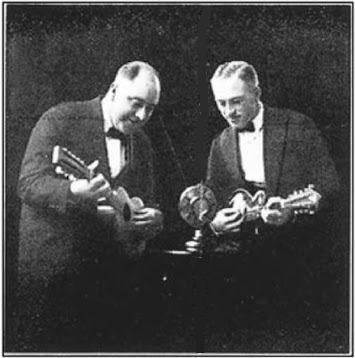
Does anyone hear a tiple on this recording, or have a picture of the Allen Brothers holding one?
It sounds to me that the Allen Brothers recording of the "Tiple Blues" was made with a guitar and a tenor banjo or banjo-mandolin, but record labels and artificial intelligence agents on YouTube spell the word with one letter P, and some conclude that the song is about the Martin (or Regal, etc.) Tiple, a 10-string instrument tuned like a ukulele, first sold in the 1920s and '30s.
I just had a conversation with an A.I. stream at YouTube insisting that the Allen brothers played the tiple, and that there are discography sources that make that claim.
I have never seen a picture of them with a tiple, and since the song lyrics that give the song its title are a reference to coal mining, it seems pretty clear to me that the song is about a coal tipple, a coal loading and sorting station.
"Ain't gonna work on no tipple, ain't gonna load no coal," makes no sense if it is talking about a ukulele.
Meanwhile, there is a fascinating Kentucky Ramblers recording of a very similar song from around the same time under the title Ginseng Blues, which replaces working on a tipple with digging ginseng, another Appalachian occupation.
Yes, I play ukuleles and guitars and banjos and mandolins... but something a friend on Facebook posted today sent my A.D.D. off on links and searches that eventually landed in a whole other musical world. I like it...
From my personal department of compulsive research, in response to a Facebook post about questions in song titles.
Here's an idea for an (as far as I know) nonexistent album, YouTube playlist, or master's thesis, titled: "Uncertainties: The questioning songs of the Carter Family."
"Will You Miss Me When I'm Gone?"
"Will The Roses Bloom In Heaven"
"Will My Mother Know Me There?"
"Why Do You Cry, Little Darling"
"Can* the Circle Be Unbroken"
"Where Shall I Be?"
"Happy Or Lonesome" (The lyric asks, "Are you still happy, I wonder, or are you lonesome too?")
Of course, some of those questions might be described as faith-based with positive answers rhetorically implied; the Carters' discography at Wikipedia doesn't always include question marks.
("Tiplista" Timmie Rogers & band... Photo from YouTube post)
https://youtu.be/Z1RCRIgiqak?si=gWcT3Jk70khYwZ4G
A decade or so after this recording, Timmie Rogers appeared singing duets with Redd Foxx on Sanford and Son, and playing that 10-string tiple -- the only time I've seen one on television.
The career retrospective in still images accompanying this YouTube video show more of his tiples, even if the amplified 10 string instrument isn't very audible over piano, drums and horns of the band in this recording.
Technical note.. I'm posting this with my phone and the Android Blogger app doesn't show me an obvious way to embed the video rather than just present a link. I'll come back with a computer later and edit this. For now, the post begins the link address simply paste it as text, and it ends below with the same link activated as an "open in a nw window' link using the app. I'm curious what the difference will be, and whether one or the other is easier to turn into an embedded video on the page.
I don't do Instagram or TikTok, so I'd been listening to Jesse Welles' songs on YouTube, Facebook and Bandcamp for some months before he made his way to the Stephen Colbert Late Show in November 2025...
He sang one song at the end of the program, "Join ICE," and another on the show's YouTube channel, "RED," for which he put on a red shirt to accompany his red Ovation guitar and the red-white-and-blue flags that served as a backdrop for both songs. I wonder how many Colbert viewers first saw Welles sing RED in a video from September's Farm Aid concert.
As someone whose earliest political education came from Phil Ochs (even via the Chad Mitchell Trio!), Pete Seeger, Utah Phillips and other topical folksingers in the 1960s and '70s, I'm finding Jesse Welles' following on social media -- and his songs -- both encouraging and a nostalgic reminder that singers can make important statements and get people listening, and a few "stars" even keep going to a healthy old age...
Heck, a couple of weeks before the Colbert show he sang both his song "No More Kings" and Bob Dylan's "Don't Think Twice, It's Alright" with Joan Baez at The Fillmore in San Francisco on Nov. 4, all uploaded to Facebook by fans in the audience.
(Also preserved: Jesse leading a sing-along of John Fogerty's "Have You Ever Seen The Rain," with 84-year-old Joan dancing joyfully stage and giving Welles a kiss on the cheek at the end. "The torch has been passed," one of the comments says.)
(Here's a link to "Red" from the Colbert show, since I'm having trouble embedding a third YouTube video on this blog page. Maybe it's time to re-learning how to use the Blogger editing system on my MacBook instead of using the Blogger app on my Android phone.)
The other song I've been thinking about enough to go searching for on YouTube and elsewhere is Phil Ochs' warning to performers, "Don't Play the Chords of Fame," as recorded by Phil himself -- once with John Lennon, and by Melanie Safka at Phil's memorial concert in 1976, which I stumbled on online, then wound up spending a nice afternoon listening, remembering, and reading Phil's detailed biography at Wikipedia, among other things.
I'm wishing Jesse Welles the best as he packs for already sold-out European and Australian tour dates over the next two months. I considered rushing to get tickets for his February shows in Asheville and Knoxville, but the ticket prices and three-hour drives discouraged me, and now a week later they're sold-out and wait-listed.
I can't help noticing on his Wikipedia biography that (unlike Baez, Dylan or Ochs) his "overnight success" these past two years came when he was already over 30, although his fans on Facebook and YouTube frequently comment about "this kid," which makes me think they are closer to my age than his, closer to the generation whose young 1960s activists used to say we should "never trust anyone over 30." Fans sang him happy birthday last week at concerts in New York, so I suspect they all know he was born Nov. 22, 1992, according to Wikipedia.
As a New Yorker subscriber, I'm still waiting for one of their legendary "profiles" on this guy from Arkansas, but a search of the magazine website found the New Yorker writers already quoting his songs when taking America's cultural temperature -- probably starting a year ago in a piece about the shooting of Brian Thompson, the chief executive officer of UnitedHealthcare, which Welles had written about.
"The standout among the neo-murder balladeers is the topical folk singer Jesse Welles, whose delivery and persona takes John Prine’s craggy empathy and adds a tincture of Brian Jones’s sinister charisma. His “United Health” dispenses with Thompson’s death in record time (“The ingredients you got bake the cake that you get”) and manages a potted history of the titular company inside a single verse (“Way back in seventy and seven / Mister Richard T. Burke started buyin’ H.M.O.s. . .”). It also neatly encapsulates the economic logic of for-profit insurance: “There’s an office in a building and a person in a chair / And you paid for it all though you may be unaware / You paid for the paper, you paid for the phone / You paid for everything they need to deny you what you’re owed.”
“There’s a mutually agreed upon mediocrity between the students and the teachers and administrative faculty,” the folk singer Jesse Welles explains, in his song “College.” “You pretend to try, they’ll pretend you earned the grade.” If you want to be a doctor or an engineer, Welles sings, college might be worth it; otherwise, you might “skip the Adderall prescription,” and acquire “a YouTube subscription.”
Manhattanites got to see Welles in person last February or, if they missed that tour, to read about him in The New York Times (Feb.12, 2024; free link):
"Welles, a singer-songwriter with a shaggy, dirty-blond mane and a sandpapery voice, has risen to recent prominence posting videos to social media of himself alone in the woods near his home in northwest Arkansas, performing wryly funny, politically engaged folk songs. He’s managed to turn subjects like the war in Gaza, the rise of the weight-loss drug Ozempic and the rapaciousness of United Healthcare’s business model into viral hits on TikTok and Instagram, building an audience of more than 2 million followers on those platforms."
Personally, rather than join the crowds when he gets back to the U.S.A. for two months of already sold-out shows, I stopped by Bandcamp to buy a record and liked the note posted there that all sales proceeds to the end of the year are going to charity. Now I'm waiting for a songbook... or at least good discussion of a fan's comments that he must be using artificial intelligence to crank out so many good lyrics, which I certainly haven't finished reading online.
"... often short and satirical tunes, riding on his coarse voice and fingerpicked guitar strings, that respond to the major headlines of the week. They challenge the narratives presented to Americans by governments and corporations; they draw historical parallels and unearth underlying tensions that lead people to blame one another for institutional injustices."
Here's one more thoughtful article that "arrived after deadline," calling Jesse "A Populist for Progressives" ..
And, finally, I just noticed which of Welles' many videos has the most views on YouTube... and, surprise, it's not something he wrote -- and it's not a solo. At 3,259,494 views and rising*, it's an Oct. 31, 2024, backporch (or front porch?) video of John Fogerty's "Have You Ever Seen the Rain?" -- sung by Jesse in the foreground, but swapping verses with Matt Quinn of the band Mt. Joy up on the porch. Quinn has also performed with Welles on stage. (Maybe some of those clicks are from other guitar players trying to figure out Quinn's guitar tuning, which appears to be a fourth low, baritone-style. I've got one of those myself.)
Notes:
Nov. 26 update -- *-the YouTube play statistic on that last clip rose by more than 100 people in the five minutes it took me to add it to this blogpost. Somebody else must be linking to it!
Apologies for the erratic appearance of this page... I've added links at various times using Blogger on a MacBook and with Blogger's Android app -- which caused the YouTube videos to disappear. I'm pretty rusty at this stuff.
Meanwhile, thanks to one viewer for asking if there was a way to subscribe to this blog -- something I haven't investigated adding since changing it from an academic tool to a post-retirement personal bookmark list and diary of my musical interests. If I write in it more often, maybe I'll risk trying to update its layout and incorporate an RSS feed or email subscription widget.
I shared this on Facebook this morning adding lots of links to Pages for some of the people mentioned , and leaving questions about how long the program "Let's Sing Out!" was broadcast back in the day...
I love it when serendipity brings this particular episode of Oscar Brand 's singalong folk music program from 1966 Canada to the top of my YouTube feed. It includes Maria D'Amato and Geoff Muldaur in great Jim Kweskin Jug Band numbers... the "folk revival" romance that changed her name to Maria Muldaur before her solo career started.
It's also fascinating to hear host Oscar Brand and his Canadian studio audience sing an abolitionist American Civil War song that probably has never been sung with those verses on American television... and there's more beautiful singing by Len Chandler and Bonnie Dobson, shown in the still frame that Facebook should be placing with this text has a link to the video.
I'm pretty sure that by my freshman or sophomore year in college I had records by all of these performers, but never got to see *any* of them in person or on American TV. :-(
(I caught up with a few of them at folk festivals or concerts eventually -- worth the wait, even 10 to 40 years later.)
For a bonus, hold on to the end of the recording to hear Len Chandler's tribute to topical songwriting, "If telling where it's at is out, I don't want to be in," written (with a beat) when commercial folk rock was distracting the audience from the Vietnam War and Civil Rights protests. Reminds me of what Cathy Fink and Marcy Marxer, Tom Paxton and more are doing to bring back topical songwriting today. Maybe they could even update Len's song?!
Footnote: Jeannie Brand-Derienzo, Oscar's daughter, wrote back to say the series was broadcast from 1963-67. I noticed that Wikipedia has a Let's Sing Out! page, which says the show began on the CTV Television Networkfrom 1963 to 1966, then moved to CBC Television until 1968, but there was no full list of performers. But that led me to a Canadian TV history website for more details: The weekly Friday night show was begun by producer Syd Banks on the commercial CTV network, moved to other nights in later seasons, and in an unusual move, the national "public broadcasting" network CBC picked it up in 1967 and also offered reruns in summer 1968.
Unfortunately the broadcasting-history.ca site also has no comprehensive list of performers. However, searching the site for Oscar Brand lists eight series that he had some part in, including a cutely named Sunday evening "Brand New Scene," produced by the same Syd Banks for CTV when his Let's Sing Out! moved to CBC. Banks also produced a Tuesday night "A-Singin'", but both of those shows which only lasted a season. Skimming the YouTube posts, I've seen at least fragments of "Let's Sing Out!" with performances by Joni Mitchell, Jimmy Driftwood, Dave Van Ronk, Simon & Garfunkel, the Simon Sisters, the Chapin Brothers, and more. Several of Joni (Anderson) Mitchell's appearances have been clipped and uploaded to YouTube, sometimes with only glimpses of other performers, like Patrick Sky and the Chapins. Here's are a couple of examples...
If there are full-length recordings of those dozens of Canadian broadcasts, they should have their own cable channel or a box of DVDs for sale today! But even having a few clips out there where folks can see it now is a joy! Come to think of it, if the ABC Hootenanny format of college campus concerts by folk-revival performers inspired "Let's Sing Out!", I count that as a positive contribution the often-maligned ABC Hootenanny show made to the universe, along with bringing the Chad Mitchell Trio, Josh White and Judy Collins, and a positive image of college campus life, to my home TV screen when I was still in high school. ❤️
I do wish Hootenanny had welcomed Pete Seeger and more of the traditional singers he had on his less widely heard "Rainbow Quest" TV show. Today, I'm happy to see Rainbow Quest has made it to YouTube too -- almost 37 hours worth, with Pete joined by old-time, bluegrass, blues, Irish and topical singers!
Hmm... I wonder how many official over age 62 "old timers" are going to show up for this event I just read about today?
I wonder if I can learn to play the fiddle in 30 days? I got my first fiddle at age 70 and did take a few lessons about 6 years ago, even though I decided an injury to my right hand made it too awkward to hold the bow, but I do still have a fiddle.
If only they had started the old-timer category at 75, I might even have a chance, but I don't know about competing about all those talented, full of get up and go 60-somethings who have been playing since childhood.
"What's on my mind?" a certain social media app asked me this morning. Honestly, for some reason, what was on my mind was the word vestibule, particularly vestibules as places worth mentioning in popular song.
When Helen Kane boop-boop-a-dooped her way toward musical stardom by singing the song "That's My Weakness Now" in 1928, she did not mention a vestibule. When Cliff Edwards, aka Ukulele Ike, recorded it a few months later, he did. And there was something in the tone of his voice that suggested more things went on in vestibules than I was aware of.
Helen Kane wasn't the first to record it. Among the others were Paul Whiteman's band with the Rhythm Boys, including a young Bing Crosby. The database doesn't list any other women singing it, though. Is it wrong?
This also made me want to go find the original sheet music to see what original verses Helen might have left out to do her boop-booping, including with the vestibule reference -- if it was in the original publication.
I guess I'm not really tempted to write a musicology master's thesis on the significance of the vestibule in popular song lyrics, if someone else hasn't done it already, or doesn't see this post and beat me to it.
But, honestly, from Sam Stept & Bud Green to Chuck Berry to Bruce Springsteen, They Might Be Giants, and Wu-Tang Clan, they've all been to the vestibule for inspiration. You could look it up! My favorite discovery was a John Prine song I had never heard!
Kane's version, says CatsPyjamas1 at youtube, <<Charted at #5 in 1928. Helen's first record release. Also #17 for Russ Morgan in 1949. With the Nat Shilkret Orchestra. Also recorded by Cliff Edwards in 1928. Written by Sam H. Stept and Bud Green. Recorded July 16, 1928. B-side is "Get Out and Get Under the Moon".>>
If you haven't guessed by now, this post is an attempt to salvage all the impulsive research that I did on Facebook this morning and post it out here where folks on the free and equal web can see it. It will probably take me a couple of visits to add all the links and lyrics here, because I started this with several apps on my smartphone and my eyes are getting tired.
I sure found out a lot about vestibules in popular song. But I'll have to edit this on my laptop to add some YouTube videos!
End of the first draft at 12:39 on Friday the 13th of June 2025, with some updating a dozen days later.
Another YouTube user has built a 30-song Frank Crumit playlist, so I'll be listening to his great old-time songs -- and for the jangly sound of the tiple! (What's a tiple?)
I think "Ukulele Lady" was the first Crumit classic I ever heard... and I think my mother sang "What Kind of Noise..." On both, it sounds like Frank and accompanists used uke, maybe a mandolin-family instrument, and other backing instruments, but I don't hear a tiple... and the image with the second video looks to be another member of the ukulele family, an eight-string "taropatch."
I haven't even seen the A Complete Unknown Dylan-goes-electric movie yet, but Facebook discussions around it and conversations online with 1960s music scene survivors have really sent me down a week-long memory search and musical rabbit hole. (Come to think of it, I'm much more successful at being a complete unknown than he is.)
For one of those Facebook conversations, I assembled this musical still-life photograph, which brought back more memories, eventually hypertext-assisted into this blog post. But I started out slow, drawn back into playing old songs from those books for the living room furniture. For instance, I couldn't believe that the 1963 M. Witmark and Sons portfolio of songs from Dylan's second album (purchased new, when $1.95 was a non-trivial sum for a high school kid) came with piano arrangements, with little chord diagrams for guitar players. I also have the similar volume for his third album.
Guitarists reading this will be charmed to learn that book gave the guitar chords for playing "Blowin' in the Wind" in the key of Eb -- without suggesting use of a capo. "Girl of the North Country" was in Ab. (I still have never mastered the Db chord fingering it suggested, although the Eb 7th fingering has come in handy, pushed up a half step.) In any case, these were not keys I could play or sing in, so the book was a fine education in chord transposition.
However, "With God on Our Side" was presented in the key of C, where Dylan played it, and I see pencil notes indicating that 16-year-old me was already figuring out the harmonica solo! Unfortunately, or fortunately, my voice couldn't hit the high notes in that one, which may be why I backed off on the idea of singing it in a 1964 "hootenanny" at my high school. Or maybe I was just chicken. It was a Catholic high school, better at teaching grammar than progressive politics, although mimeo copies of "The John Birch Society" were circulating thanks to one teacher, making me a Chad Mitchell Trio fan.
I did sing San Francisco Bay Blues in that hootenanny, with the guitar and the harmonica, and some classmate introduced me saying I sounded "something like Bob Dylan, but that's not a bad thing." Actually, I learned the Jesse Fuller song from a transcription of a Ramblin' Jack Elliott performance, not from Dylan, and I don't think the emcee had never heard me sing or play; I think he was just judging by the hardware around my neck.
Thanks to Jeannie Brand-Derienzo, another Facebook friend, for sending me that mint copy of her dad Oscar Brand's instruction book, which was where I started learning to play the guitar. I think I traded away my original copy, and my first guitar, for my first banjo -- while I was still in high school. I still have an LP of Oscar singing historical satirical songs like, "A dollar ain't a dollar anymore" and "The Dodger Song," which still seem quite timely. (Feel free to join in while you read the rest of this. The lyrics are on those two links, one an Aaron Copland arrangement, but I prefer Oscar's singing below.) I also have several of Oscar's books and song collections.
I never did get to meet Oscar Brand, or even see him in person, but his books, records and broadcasting career were a huge part of my 1960s folk music education -- and I appreciate his work even more recently, thanks to YouTube's sharing of clips from his Canadian television show, "Let's Sing Out," with guests including musical heroes of mine who I never saw on American TV, including Dave Van Ronk, Joni Mitchell and the Jim Kweskin Jug Band. Oscar's WNYC radio show "Folk Song Festival" is online in bits and pieces too, including clips from his 1961 interview with a very young Bob Dylan, making up stories about his past. But over the years coffee houses (The Exit in New Haven, the Sounding Board in Hartford), plus bars, clubs and concerts did give me a chance to hear -- and even meet -- some of those musical heroes in person. And get on stage myself. At Pinewoods, along with the banjo lessons with Paul Brown, I took classes with the great Irish sean nos singer Joe Heaney, Janette Carter (founder of the Carter Family Fold here in Virginia), west coast oldtime music encyclopedia Hank Bradley, singer and dance caller & teacher Sandy Bradley from Seattle, the Horse Flies from Ithaca, and more. Some of those other Pinewoods faces have reappeared in other states and other decades, including a hammered dulcimer player I met at a Blacksburg jam session who figured out we had been "campers" at Pinewoods that same week some 35 years earlier.
That banjo had hung on the wall for a dozen years before I took learning it seriously, first from books by Pete Seeger and Peggy Seeger, then some recorded lessons by the late Happy Traum, whose Homespun Tapes banjo course I won in a photo contest at Pickin' magazine. My entry was a picture of Connecticut fiddler Will Welling at a New England Fiddle Contest in Hartford. Will gave me a copy of his tune book in return for a copy of the picture, and I had it in my guitar case when I went to Pinewoods, which was also where I acquired my first mandolin and started to pick tunes out of that book over the coming weeks -- and years.
But guitar with Hank Bradley and banjo with Paul Brown were my official instrumental classes at Pinewoods in 1978 or '79. Paul played more fiddle in the next class I took with him, with Terri McMurray playing banjo and banjo-uke, and both of them sharing wonderful stories about the old-time musicians they had learned from in the '60s and '70s. That class was in 2015 at the Augusta Heritage Workshops in Elkins, West Virginia. (Paul and I had a lot of catching up to do come including two journalism careers, his with NPR, mine with newspapers and magazines. And now he's writing his own thoughtful newsletter about public affairs, while I dither around on Facebook and three intermittent blogs.)
I emphasized Paul in the Facebook post this longer essay is partly copied and pasted from, because he and I have a lot of mutual Facebook friends. And his banjo class really was great, but the two-week stay at Pinewoods also included folksong classes with older singers I admired, my first Appalachian clogging class with Bob Dalsemar (teacher) and Ruth Pershing (teacher, caller, and dance ethnograper), and meeting lots of new friends and dance partner.
Dance partners, especially. Come to think of it, "You'll love it; it's like Club Med in the woods," was a friend's motivating line that probably has never appeared in the Country Dance and Song Society brochures. CDSS was and is a great dance and music community, and I did try commuting from Hartford to New York on Amtrak for most of a year to keep a romance going with someone I met at Pinewoods. But the music pulled me in another direction -- grad school in anthropology and ethnomusicology at Wesleyan, which I started at the rate of a course a semester, my tuition paid by the newspaper where I worked -- whose generous fringe benefits probably helped keep away unions for 200+ years.
After a couple years of part-time study at Wesleyan, I'd been at the Hartford Courant for 11 years, and was able to "retire" the year the paper was sold to a chain. I cashed in my employee stock so that I could finish off my studies full-time, including a 10-week research summer in County Mayo, Ireland, meeting great folks like John Hoban. To learn some jigs and reels, and accompany John Prine songs in the pub, I carried along that mandolin I'd bought at Pinewoods from a great guitar player named John Pearse. It was an old Martin with a broken side he had repaired while working for the Martin guitar company. He left to found his own company, making guitar strings among other things until his death in 2008. I still use the strings with his picture on the package. Greg Ryan, from New York, was my mandolin teacher in Ireland, picking up where I'd left off with classmate Jim Cowdery at Wesleyan. I kept that mandolin for 40 years before selling it to a friend who still plays it on stage and at jam sessions here in Southwestern Virginia.
Unlike Dylan, I did not take to songwriting or get very good at singing or entertaining audiences, or ever get to play on stage at the Newport Folk Festival. But, ironically, after I stumbled back into journalism, I did wind up on stage at Newport once, in the early 1990s. I was there taking pictures of my favorite harmony-singing trio, The Roches (shown earlier). I was trying to find a photo angle that would put enough pretty sailboats in the background to convince the editor of Soundings, a boating magazine, to put the picture on the cover, along with my article about "boats and music." Her reply, "Nope, boats have to be in the foreground on the cover."
But the article and a few pictures did run inside the magazine, and living around the corner from Soundings in Essex, Conn., also put me around the corner from the Griswold Inn, which briefly landed me and that old mandolin in a sea chantey singing group (Cliff Haslam & the Jovial Crew). We even played the Mystic Sea Music Festival once, around 1992, before I went off to grad school again, at UNC in Chapel Hill... which in a roundabout way brought me here to Southwestern Virginia, retired from teaching journalism, and playing old time music at jam sessions and dances. (Maybe this is the summer I'll get to the Mystic festival's successor, the Connecticut Sea Music Festival, with its roots in Cliff Haslam's Griswold Inn sessions. Alas, it's usually the same weekend as the Mount Airy Fiddler's Convention in North Carolina, which has become an annual ritual for me too.)
No wonder my house and brain are so cluttered with instruments and the musical memories sampled in that photograph. By the way, only the Burl Ives book and the 1930s Kay mandolin in that picture were acquired "second-hand," but it is all secondhand music, full of memories and history, and that's what I like about it.
It's not entirely relevant to this musical discussion, but (also in a roundabout way) my 1978-83 master's degree in ethnomusicology led to a 1988 master's about hypertext, which is why there are 30 or more links here to Web pages, YouTube videos and podcasts. A late-in-life diagnosis of ADHD may have more than a little to do with it too, and I hope some readers find them as enjoyably distracting as I did. Onward...
The Golden Melody Boys, who I've read about at Discogs and OldTimeBlues, were also The Georgia Melody Boys -- perhaps a case of using different names for different record labels, since they were from Cedar Rapids, Iowa, not Georgia. I'm glad that 78 RPM record collectors have preserved some of their recordings.. and have even put them on youtube.
Here are a few, starting with an embedded video of the most recent I've heard...
Goin' to have 'lasses in the morning (an Old Dan Tucker variation?):
I'll continue adding their recordings to a Golden Melody Boys YouTube playlist as kind souls share songs from old 78s there! At first I was surprised that YouTube's nine songs seemed to be more of their recordings than the Discogs record-collector database for the Georgia Melody Boys -- but then I discovered the two-names situation and saw that Discogs lists them separately, with four two-sided records as "Georgia" on the Broadway label, all duplicates of songs from their seven two-sided records as "Golden" on Paramount. YouTube has some catching up to do; nine down, five to go, and maybe one of those five is already there -- since whoever uploaded Side A probably did Side B too, unless it was too damaged to digitize.
Discogs identifies the singers and players as Phil Featherstone on mandolin and sometimes harmonica, andDempsey Jones on tiple, and as writer of their two-part dialog, "Uncle Abner and Elmer at the Rehearsal."
I hope to find more and better (less scratchy) transcriptions eventually, but from my early listening, the duet neatly illustrates my feelings about the two instruments... that the mandolin is better suited to melody or chord-melody playing, while the Tiple works best as a rhythm-chord instrument, given its doubled and tripled strings in ukulele tuning.
New to the tiple? Being tuned like a ukulele (gCea or aDf#b) means that when played at the same fret, the three lowest-pitched double and triple-string courses make a major chord (C for some players, D for others), while the three highest pitched make the relative minor chord. Sliding those positions up or down the neck can be very satisfying.
Since a ukulele playing friend of mine is learning the mandolin, and I have mandolins, ukes and a tiple, maybe we can work up such a duet.
Reminder to self: Put new strings on the tiple! When the steel string bronze windings wear out, leaving little gaps, those nice sliding chords you hear on this recording slice through the calluses on my favorite left hand fingertips and can leave behind little splinters of bronze wire. Ouch!
(Yes, I've replaced the strings since writing the first draft of this. Added that YouTube playlist too.)
Some wonderful songs here, including "Teddy Bears' Picnic," "I Told Them All About You," "Smiles" and more... This is last night's episode, Number 1374 of Craig Ventresco and Meredith Axelrod's YouTube and Facebook streamed "KitchenCast," an almost-nightly live event that began when the pandemic cut into their local gigs in 2020. Posting this episode here will help me share it, find it again, and -- as a bonus -- remind myself how to embed a YouTube video in Blogger, which I haven't been using very often recently. More examples and some extras from my Department of Compulsive Research below!
Just to see if I've got that embedding technique down, here's a one-song YouTube post from Meredith and Craig, from before the start of their pandemic streaming show four and a half years ago, "The Cubanola Glide," which I like because the town I live in has old Cubanola Cigar advertising painted on the walls of a couple of downtown buildings. I also like Meredith's ukulele playing, and the fact that they make eye contact with each other more than they do when they are watching Facebook and YouTube comment streams like they do in the live Kitchen Cast.
If you'd like to sing along, I found the sheet music a while ago. It looks like Meredith and Craig are playing in the ukulele and guitar friendly keys of G and C, while the original (piano) sheet music has the verses in Bb and the chorus in Eb.
By the way, they are both right-handed, but their Facebook stream and occasional YouTube clips appear with the image reversed. This "Just Another Day Wasted Away" clip not only shows that phenomenon, it also has some lovely harmonizing and "voice trumpet" or "blue blowing" by Meredith.
Meanwhile, for old-song fans, here are the "Second Hand Songs" pages for the tunes I've mentioned above:
In a rare blogging crossover, it seemed appropriate to write in my other blog today about the Cardinal News article tracing the history of The Crooked Road, Virginia's Heritage Music Trail, and put a link to that "Other Journalism" blog here. That item turned into a personal collection of links and memories about Virginia newspaper websites, the Internet Archive, and a sneaky self-serving plug for a performance by "Bring the Feet," at the November 9 Floyd Contra Dance.
In its opening photo, look for my mandolin waiting on my chair, at the right. I'm in the background, wearing a tan "Dittyville" cap and holding a cup of coffee, talking to Bring the Feet's hammered dulcimer and keyboard virtuoso, Randy Marchany, in a plaid shirt, bottle of orange soda in hand.
More recently, when a Floyd fiddler was putting together a band for the (post-Covid) revived Floyd dance, she asked if I knew anything about New England contra dance music. I admitted to 30 years of dancing and a few occasions of sitting-in with legendary caller Ralph Sweet in Connecticut. More importantly, I tipped her off to Randy's "No Strings" past, and he mentioned that No Strings' bass player was also available. So a band was born... for at least one dance a year. (Actually, this is our fourth for 2024!)
I just realized that the other blog post, while mentioning that Cardinal News reporter Ralph Berrier Jr. is an old-time and bluegrass fiddler, failed to mention his band, The Java Brothers, or his book about the bluegrass music careers of his grandfather and great-uncle, "If Trouble Don't Kill Me." Here's a YouTube copy of a Java Brothers concert ...
The commenter who got my attention said they always thought the song was from the 1960s. (It's actually from the 1860s, as someone pointed out in the same discussion.)
I mentioned to one of my journalism classes 15 or so years ago that on the weekends I played "old-time" music. A student responded, "You mean, like, Sinatra?"
No, I said, I meant, like Mike Seeger and perhaps his older half-brother Pete, and the older folks from North Carolina, Virginia and West Virginia that they learned from.
A Facebook discussion earlier this month has sent me down a compulsive-research rabbit hole to a Wikipedia page about "Old-Time Music," which by one of its definitions I still play every Sunday afternoon and Wednesday evening at southwest Virginia jam sessions, and which -- by other definitions -- has fascinated me since I bought my first Pete Seeger and New Lost City Ramblers albums during the 1960s "folk music revival" (Or "The Great Folk Music Scare," as Utah Phillips or someone else called it.) The 20-year-old Wikipedia page has had numerous editorial additions and changes over the years, but its most prominent feature when I got there were a few prominent "citation needed" notices and a somewhat random use of Wikipedia's "references" feature.
My own "primary sources" for learning about "folk music" were big library books, but the phrases "old-time" or "old-timey" music in the 1960s and '70s came to me mostly from LP records and their liner notes, so I've added some of those as references on the Wikipedia page, as well as more recent books I've at least browsed through. A fine CD box-set that came out a few years ago made it very clear that New York's "Friends of Old-Time Music" or "FOTM" used that name as a broad umbrella for "authentic" or "traditional" folk music concerts and records, to avoid confusion with the commercialized singer-songwriter and "interpreter" artists being marketed under the "folk music" banner in the 1960s. The New Yorkers who ran FOTM, unlike the 1920s record companies that used the phrase "old time music," included black guitar players like Mississippi John Hurt under the heading, and older bluegrass bands that had roots in older fiddle and singing styles and perhaps less influence from Nashville record producers ideas of commercial country music. French Canadian and Louisiana Cajun fiddlers also appeared in "old-time" concerts.
Nowadays, "old-time music" is more specifically a fiddle-contest and music convention category to distinguish pre-bluegrass fiddle-and-banjo playing styles in Appalachia, the Ozarks and elsewhere. And today some young players are eager to point out the segregation-area exclusion of black fiddlers and banjo players from early 20th century "old time" records, and so have been reclaiming recognition for the black performance styles that influenced white players, as well as the black origins of the banjo -- an instrument with African antecedents that fell into white hands in the early 19th century and became an international fad after white-impersonators in black makeup created the "Minstrel Show," leading music-instrument factories to mass-produce banjos, and variations on the instrument found roles in Dixieland, Ragtime and Jazz bands, even crossing the Atlantic into Irish music on tenor banjos and British pop-songs accompanied by banjo-ukuleles. Both the banjo and old-time fiddle have separate Wikipedia pages, by the way. I'm staying away from those.
Back to "old-time music"; those early U.S. record companies had separate "race" labels and catalogs, which presented black blues and gospel performers, but the producers appear to have left the old folksongs and fiddle tunes to whites, along with most 20th century banjo playing, all featured under headings including "hillbilly," "mountain music" and "old-time" and "country"... industry distinctions that got even more complicated with the later recording categories "country and Western)," "folk music," "rhythm and blues" and "rock 'n' roll." But that's another story.
The whole Wikipedia old-time-music page seemed to assume the definition of that phrase was written in stone somewhere, but so far I haven't turned over the right rock.
The page was -- and still is -- weak on citations. Its history section gave a lot of weight to a 2021 website article from the state of Washington, about as far as you can get from Appalachia, but this music has been getting around for a couple of centuries or more, and the article itself seems quite good, even mentioning a few promising book titles. It's available online for free here:
If you save the Wikipedia "page" as a PDF file, which I've finally done, it is 13 pages long. (The banjo page is 22; the old-time fiddle page is 9 more.) I've added a few more "old-time" references at various points, but I'm hoping others with both knowledge and a compulsive attitude toward footnotes and coding Wikipedia citation styles will also come to the page's rescue. For now, I've worked more than a half-dozen sources into sections of the page, but my citation style is an inconsistent mess, which I blame on Web cutting-and-pasting while just using a smartphone part of the time... Pasting them into this Blogger editing system will probably create another formatting mess, because I haven't used Blogger much in years, and won't have much time today to come back and clean things up after I hit "Publish."
But here they are:
Huber, Patrick, Linthead Stomp, The Creation of Country Music in the Piedmont South; University of North Carolina Press, 2008
Ritchie, Fiona and Orr, Doug; Wayfaring Strangers The Musical Voyage from Scotland and Ulster to Appalachia, University of North Carolina Press 2021, 2nd ed.
Jamison, Phil; Hoedowns, Reels, and Frolics: Roots and Branches of Southern Appalachian Dance, University of Illinois Press 2015
John Cohen, Mike Seeger, Hally Wood, eds.; Old-time string band songbook, Oak Publications, New York, 1976.
Another Bob S, from the 3rd Street Coffee House in Roanoke, just proposed the idea of naming a section of street there for John Prine. I don't know much about Roanoke, and I've never made it to that coffee house, even though it's only an hour or so away, but the street-naming campaign it sounds like a fine idea...
I didn't get to John's last concert there in November, 2019. I forget why. And I forget whether I apologized for missing the show when I ran into him a month later at a guitar shop in Nashville.
But we did talk about the first time I saw him forty-some years earlier, and the pictures I took of him and Leon Redbone that day. John died of covid a few months later, before I could get back to Nashville to give him one of those pictures.
Meanwhile, if Chicago hasn't already done it, that City should name a bunch of places after the great singers and songwriters it has produced... They could start with two intersecting streets so folks can gather at the corner of Prine & Goodman ... Maybe put a diamond shaped park there, and make the opposite corner of the intersection of Sam Stone & Flag Decal.
And Chicago should have a footstep trail named for Steve, leading from Wrigley Field, where he watched the Cubs play, to Union Station, where he boarded the City of New Orleans.
An amazing 90-Minute Sextet (band name potential there!) with Meredith & Craig, in the bigger Bay Area living room of Eric (off camera, but i hear his mandolin at times) and Suzy Thompson, and duo Valerie Kirchhoff (vocals) and Ethan Leinwand (piano), a.k.a. the StLouisSteadyGrinders (dotcom).
Meredith, Suzy and Valerie ragtime-era blues harmonies are wonderful... but it's all wonderful...
I posted part of this essay in a Facebook discussion among "old time" musicians who play the 20th or 21st century compositions of the late Midwestern fiddler Garry Harrison (1954–2012) -- but sometimes without getting the tunes exactly the way he wrote them.
Jam session players' simplified versions of his tune "Red Prairie Dawn" set off a substantial rant recently by one of his fans, passionately requesting other players to preserve the intricacies of the tune. The discussion set me off on a compulsive morning of Internet research. I don't think I had ever heard Harrison's name before.
I was happy to find that tune on YouTube, and I think I have heard it in concerts or jam sessions, although I never knew the name or attempted to learn it... (I primarily play the mandolin in sessions focused more on old Virginia and North Carolina tunes, not contemporary tunes written in an old-time style.)
Trying to find out who Harrison was turned out to be a little harder than finding his tunes. My first Google search discovered several websites about a similarly named, but entirely unrelated, South Park cartoon character ("Gary," not "Garry") ...
Simply adding the word "fiddler" to the search quickly sorted that out, and also revealed that along with being a much loved fiddler and composer, Garry Harrison was also a collector and organologist studying "fretless zithers."
I have known players of some of those, so I went looking for his research, and fell into another question that fascinates me... the preservation of access to creative websites.
Harrison built an impressive website, originally at "fretlesszithers dotcom," but apparently his heirs did not maintain the registration for the web domain, although they reportedly tried to saved his writing and photographs elsewhere. There is a mention in the memorial page linked below that his instrument collection and a copy of the website were donated to an Arizona Musical Instrument Museum, but my quick search for his name there proved unsuccessful.
However, more than one copy of the original Fretless Zithers website, was saved at the Internet Archive's Wayback Machine before its original and secondary addresses expired. I was pleasantly surprised that the archived home page from 2012 even plays the site's original background music, since archive copies often are unable to maintain multimedia data, depending on file formats and other technical details. Here it is:
Here's a YouTube sample of one of Phillips' recordings -- which may inspire you to read Harrison's research revealing what ethereal "fretless zither" family instrument he was playing:
And here is the 2013 internet archive Wayback machine copy of the introduction to Harrison's FretlessZithers research.
For anyone else who had only heard his fiddle tunes without knowing Garry Harrison... this memorial page by another expert on uncommon instruments was the most expensive biography I found.
My browsing the Internet Archive Wayback Machine for the pages above began simply because a link from that memorial to Harrison's "fretless zithers" no longer worked.
Some people get passionate about preserving fiddle tunes as originally played, before people forget the original composer, and for similar reasons. On the other hand, I get a bit obsessed about preserving access to creative work on the internet, such as Garry Harrison's fretless zither website.
That's probably because 20 years ago or so I decided to focus more on writing web pages than writing for peer-reviewed academic journals or commercial publication. As a journalism professor who wrote a doctoral dissertation about early web production, I was also frustrated to see so much of the creative work of the first 10 years of the World Wide Web disappear because creative tools and design standards changed, and publishers simply abandoned the originals.
I wonder if, someday after I am gone, readers (you?) might be finding this essay in an internet archive copy of one of my my blogs, with links to or from my original stepno.com home page!?
Jan.14, 2024, First draft, also an experiment in copying text from Facebook to an intermediary editor, and on to this "Blogger" software android app. I may have to come back with a browser-based page-editing system to correct errors, remove duplication, and make the YouTube video link turn into a video player. But so far, so good. I don't edit this blog very often, so it may be in the present condition for a good long while. But please drop me a line if you see major errors.
I let writing a "get well soon" email to a Blacksburg, Va., friend get out of hand, after hearing she had to cancel her monthly porch-picking jam session because of covid... The result, a couple of therapeutic listening suggestions for any others facing the 2023-24 season of flu-plus-covid:
The last time I was stuck inside with covid I discovered these two online "oldtime" musical phenomena ... Here they are in case any of you (knock on wood) wind up at home recuperating, and are tired of TV.
The first is clawhammer banjo virtuoso Cameron DeWhitt's audio podcast -- recorded as he travels the music festival circuit playing with and interviewing elders and others who are part of "old time music" scenes all over the country.
He calls it "Get Up in the Cool," after an old tune, and in various episodes he's even "gotten up" with my banjo and guitar teachers (and Ithaca-based banjo-ukulele inspiration Jeff Claus), all of whom I met at Pinewoods Camp in Massachusetts 40 to 45 years ago.
My teachers back then were, for banjo, Paul Brown, and for guitar (since I hadn't touched a mandolin or fiddle yet) Seattle's Hank Bradley, who plays every instrument (as does Paul) and Hank's conversation with Cameron includes a wonderful story about hanging out with Doc Watson and blind mandolin and fiddle player Kenny Hall in the 1960s, along with the interesting geography of Hank's career in old time music.
Along with the audio programs , searchable and streaming from his website or subscribable as a podcast, Cameron does have a few video clips available to anyone searching YouTube for his name or the series title, as well as some extra features for people who donate to help him pay the bills. For example, audio-only doesn't do justice to fiddler-singer-and-dancer Sophie Wellington... but her GUitC interview last summer was fascinating too...
The second show is a different sort of "old time" -- ragtime, pop songs and blues from the 1890s to the 1930s, streamed live from their San Francisco kitchen by guitarists (and more!) Meredith Axelrod and Craig Ventresco -- for more than 1,100 pandemic and post-pandemic shows. The live stream is on both Facebook and YouTube, but I used the YouTube archive most of the time, since it straightens out the webcam image and doesn't make them look left handed. Skimming back through the archives you will even find programs with guests, including cartoonist/mandolinist etc. R. Crumb.
Craig plays guitar, mandolin, ukulele, and 12 and 4-string guitars as well as singing part of the time, and Meredith plays baritone and standard tuning guitars, ukulele, cello and vibraphone and has a lovely soprano voice that sometimes sounds like it is in a Time Warp from 1920.
This is just the most recent episode... a Sunday show starting appropriately with Craig's vocal on "Sing you Sinners," then a fancy ragtime duet. (Meredith doesn't sing for 15 minutes or so into the 50 minute episode) ..
(The livecasts on both Facebook and YouTube include live comments and requests from fans -- Pacific time 8p.m MTWThS, noon Sundays; they take Fridays off. The city of San Francisco passed a resolution in their honor when they hit 1,000 programs last spring. They kept going.)
Both "Get up in the cool" and Meredith-and-Craig have archives of hundreds of hours of music and conversation... and tip-jars to make a living out of oldtime tunes and new media...
Drop me a comment below if you'd like me to link to more-specific suggestions from their archives!
I've just joined that new social networking federation of servers called Mastodon, mostly because of my old friends who are journalists deserting Twitter. But I am curious whether the Mastodon network will also develop a music presence so I'm linking my Mastodon ID here... trying to do this at first with my blogger app on android, but I may have to come back with a web browser to actually edit the code of the page and make this link work to confirm that this site and my Mastodon ID are the same person.
Meanwhile, I've found a list of Mastodon servers that identify with specific topics. Granted most were about technical topics this early in the Mastodon game, but I was still sad that out of 59 on that list only two gave music as a main interest... One for metalheads, and one for rave/electronic fans.
But it's early yet... "Regional" was another option, but only nine of 59 chose that designation, and none was about Virginia or Appalachia. Instead, we have San Francisco Bay, Ireland, Canada, Wales, Australia, New Zealand, two for Scotland, and one for the U.K. in general.
While this was a more general blog at first, since 2009, Boblog has been for occasional writing about music, part of trying to differentiate my web writing spaces. My other blogs are JHeroes (old-time radio's portrayal of journalists) & Other Journalism, a general-purpose writerly blog, successor to stepno.com/oldblog. When I was teaching, they all sometimes served other purposes.
I have worked for two newspapers (one full time for 11 years), several magazines, four software companies, and six colleges and universities, counting part-time, freelance and student jobs. See stepno.com.






 Posts
Posts

