Showing posts with label blues. Show all posts

Saturday, January 15, 2022

When the blues hit the mountains...

 Oldtime music crossover...


While looking for the words to a less-often-heard "shindig in the barn" verse to "Blue Ridge Mountain Blues," I found several "discography" lists, including the two recordings as "Blue Ridge Blues" below... George Reneau's was apparently the first recording of the song. And Lulu Jackson's version gets left out of some of the "country music" or "oldtime music" lists, maybe because it crossed boundaries, but I'd love to read a history about how she wound up recording the song! Her "recitation" of the "There'll be a shindig in the barn" verse is, well, very special. 🙂
The song (credited to Cliff Hess under the alias Roy B. Carson at https://secondhandsongs.com/artist/84608) certainly was popular. Other 1920s recordings were by Riley Puckett, Ernest V. Stoneman, The Blue Ridge Duo (Gene Austin and George Reneau), Vernon Dalhart and more. (Hess was a prolific songwriter and pianist who had played on Mississippi riverboats, wrote songs with "blues" in the title as early as 1916, and eventually collaborated with Irving Berlin.) The song also mentions an even older "oldie," "Where is My (Wandering) Boy Tonight," published in 1877 and recorded by many artists from the dawn of cylinder and disc recordings.
"Blue Ridge Blues"
George Reneau , guitar and harmonica, from April '24
https://youtu.be/EwSaYwoZHZU and again with Reneau and Gene Austin:
Al Hopkins' Bucklebusters / The Hill Billies, 1926 or '28 (including fiddle, guitar, banjo & banjo-ukulele!, and 3-or-4-part harmony singing!)
Also as "Blue Ridge Blues"
Lulu Jackson (vcl/gtr) and piano.
December 21, 1928, rec. in Chicago, Vocalion 1242
Enough computer for today... but tomorrow (or someday soon) I'm going looking for more about Lulu! ❤
I'm afraid she gets left out on both sides of the recording-industry color line, even by scholars. I just found a blues discography note from a major reference book: "This artist was of African-American ancestry, but her recordings are essentially in the hillbilly idiom and of little blues interest." (Blues and gospel records 1890-1943 (1997), p. 430) Her versions of "Little Rosewood Casket" and "Careless Love Blues" are very nice too, and available on YouTube. Apparently enough of her 78s have been collected to be reissued in compilations like this one found at the discography website, discogs:
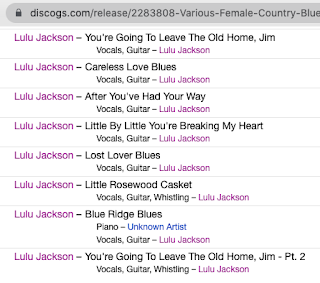
Screen image of discogs song list for Lulu


Sunday, February 11, 2018

Remembering Josh White

Happy birthday to Josh White!
(February 11, 1914 – September 5, 1969)
I saw him on the old ABC Hootenanny TV show, and soon scraped together the price of a couple of his LPs. (Ones whose album covers weren't too risque to bring into the house; it was years before I got "Empty bed blues," and I don't think I ever let my mother see it.)
I also bought a 191-page Josh White Song Book to show my guitar teacher, who had started me on classical lessons because my first guitar had nylon strings. (Nylon was recommended by the Oscar Brand book I had started teaching myself out of a year earlier. I got a new guitar, with steel strings that Christmas after convincing my parents I was going to stick with it more than I had with the accordion a few years earlier. It was a long time before I could afford a Martin OO 21 like the one Josh played on his albums, but I got it eventually.)
Unfortunately, Josh's book wasn't a guitar instruction book. The $2.95 volume (pricey in 1963; my first Dylan songbook was $1.95) featured piano transcriptions of the songs, not his original guitar arrangements. 
I did learn something about music watching my teacher try to work things back to the guitar at my novice level. And I learned other things from the text by Robert Shelton, folk music critic at the New York Times (yes, that was a job then!), who provided song commentaries and a biography of Josh.
It wasn't as thorough as Elijah Wald's "Josh White, Society Blues" several decades later, but it made me feel like a folk blues insider... and, come to think of it, those song book introductory chapters were probably the only biography of a black person that I read in high school, two years before Alex Haley published "The Autobiography of Malcolm X."
Smithsonian Folkways Recordings shared a link to a Spotify playlist with a birthday post today, inspiring my reminiscence..
https://m.facebook.com/story.php?story_fbid=10157545963179815&id=10367554814
Rather than using Facebook to share a Spotify playlist, why doesn't Smithsonian Folkways just share a link to its own web page that sells a classic Josh White album, and lets you download its 14-page LP size booklet as a free PDF? I hope it's because Folkways makes some money from Spotify. Curiously, when I tried to post that question to the Smithsonian account on Facebook, Facebook marked my comment as spam! That reminded me to put my thoughts out here on the more open web, not just in Facebook's controlled space.

Tuesday, February 08, 2011

Yet Another Blog by Bob: and couple of songs

I've been posting here so infrequently that I ought to mention why: As part of my media history research I've started yet another blog, JHeroes.com -- Newspaper Heroes on the Air, and it's taking most of my blogging time.

I'm exploring how newspaper reporters were portrayed in "popular culture" for a series of articles and maybe a book. The blog will help me sift through and comment on more than 30 years of old time radio: dramatic series, dramatized biographies and historical series.

Why? Partly because I like the storytelling of radio. At its best, it let your imagination paint the pictures, instead of some Hollywood special effects department. Professionally, I'm curious whether any "old media" (newspapers) and "new media" (radio) competition showed up in radio stories, or whether radio simply reflected how important newspapers were in daily life back then.

I also wonder whether radio dramas put newspaper reporters in a better or worse light than Hollywood movies of the same era, including whether radio had strong women reporter characters like the movie portrayals of Hildy Johnson, Torchy Blane and Lois Lane. (For more about the radio version of Lois, and her reaction to that upstart Clark Kent, see this second half of this blog entry.)

So... this old "boblog" blog has slipped off my radar for the past few months. So has music -- the main thing I write about here.

Here's one coincidence: An episode of one of the best old-time radio shows about crime-fighting newspapermen also featured one of my favorite blues singers and guitar players, Josh White.

Listen to "The Prisoner's Song" episode of the series "Big Town," although you may have to carefully copy and paste this address:
http://otrrlibrary.org/OTRRLib/Library%20Files/B%20Series/Big%20Town/Big%20Town%2049-02-15%20(467)%20The%20Prisoner's%20Song.mp3

Josh sings original blues songs that parallel the story of the radio play; to be part of the scene, he plays a prisoner on death row.
"He's going to the chair..." the guy in the next cell says. "They let him have his guitar. He wanted it instead of his supper."
Incidentally, Josh White's song here is not "The Prisoner's Song" -- that's just the title of the "Big Town" episode.

The other "The Prisoner's Song" was a huge heart-breaking hit in the early days of recorded music, for Vernon Dalhart (a No. 1 hit for 12 weeks in 1925-26).

Since then has been re-recorded many times. I even remember my mother singing it, sometimes just the line, "If I had the wings of an angel..." when she needed a quick escape from whatever was getting her down.